SEO in 2026 is no longer limited to ranking on Google’s traditional search results. Businesses now need to compete across organic listings, AI Overviews, and emerging AI-powered search platforms where users are finding information in new ways. According to BrightEdge research, organic search drives around 53% of website traffic on average, making it one of the most valuable channels for online growth. Backlinko’s analysis of Google search results found that the first organic result receives approximately 27.6% of clicks, proving that search visibility still plays a major role in attracting visitors.
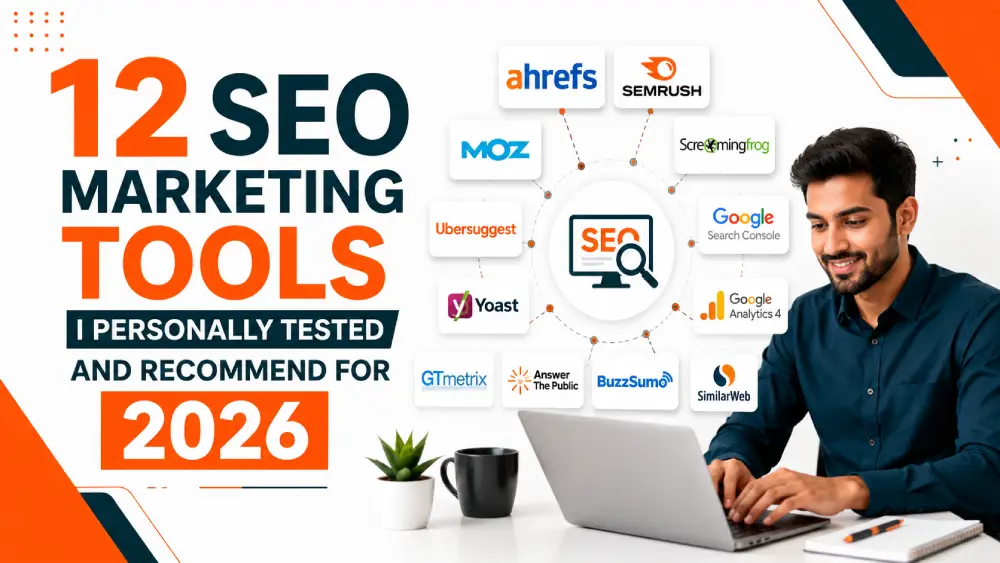
However, achieving better rankings requires more than just adding keywords. Modern SEO tools help marketers find opportunities, analyze competitors, improve content, fix technical issues, and track performance across search engines and AI platforms. I tested these SEO tools based on their features, ease of use, pricing, reporting capabilities, and how useful they are for different SEO tasks. Below, you will find 12 SEO marketing tools that can help businesses improve their SEO strategy in 2026.
What Are SEO Marketing Tools?
SEO marketing tools are software platforms that help businesses improve their visibility in search engines by providing data, insights, and recommendations. Instead of manually checking rankings, analyzing competitors, or searching for technical problems, marketers use these tools to understand what is working, what needs improvement, and where new opportunities exist.
Best SEO Marketing Tools in 2026
Before looking at each tool in detail, here is a quick comparison of their main uses and pricing to help you find the right option.
| S.No. | Tool | Uses | Price |
| 1. | Semrush | All-in-one SEO and competitor research | $139/month |
| 2. | Ahrefs | Backlink analysis and SEO research | $129/month |
| 3. | SE Ranking | Affordable SEO management | $65/month |
| 4. | Morning score | Beginners and small businesses | $69/month |
| 5. | Moz Pro | SEO basics and link analysis | $99/month |
| 6. | Google Search Console | Website performance tracking | Free |
| 7. | Screaming Frog | Technical SEO audits | $259 yearly |
| 8. | Google Page Speed Insights | Website speed testing | Free |
| 9. | Rank Math | WordPress SEO optimization | Free / From $6.99/month |
| 10. | Yoast SEO | On-page SEO guidance | Free / ~$99/year |
| 11. | Surfer SEO | Content optimization | $99/month |
| 12. | Answer The Public | Keyword ideas and topic research | Free / From $11/month |
1. Semrush

Best for: Agencies, businesses, and SEO teams
Starting price: $139/month
My Rating: 4.8/5
Semrush is one of the most complete SEO platforms available, combining keyword research, competitor analysis, backlink tracking, rank monitoring, and site audits in one place. After using it across multiple SEO projects, the competitor research tools stood out the most. They quickly reveal top-performing pages, ranking keywords, and content gaps, making content planning much easier. The Site Audit feature is equally useful for finding technical issues, though the number of reports can feel overwhelming for first-time users. If you need an all-in-one SEO solution, Semrush is hard to beat.
2026 Update: Semrush has expanded its AI search capabilities, helping marketers monitor brand visibility across emerging AI search experiences. However, pricing remains a consideration for smaller teams. The platform is still one of the strongest SEO suites, but pricing remains a concern for freelancers and small businesses. After using the updated version, the biggest improvement is the ability to monitor brand visibility beyond Google rankings. However, traditional features like keyword research and competitor analysis remain the main reason most users continue paying for Semrush.
Pros
- Excellent competitor analysis with keyword gap and traffic insights
- Large keyword database covering multiple countries and industries
- Strong reporting features for agencies and marketing teams
Cons
- Can feel overwhelming because of the number of features available
- Pricing increases quickly with additional users and limits
- Some keyword and traffic estimates still require manual verification
2. Ahrefs

Best for: Link building and competitor research
Starting price: $129/month
My Rating: 4.7/5
Ahrefs is the tool I found most useful for backlink analysis and competitor research. Site Explorer makes it easy to see which pages drive traffic, where competitors earn backlinks, and which keywords they’re ranking for. It also performs well for keyword research and content discovery, although the interface is better suited to experienced SEO users than complete beginners.
2026 Update: Ahrefs has introduced AI-assisted features, but its main value remains backlinks, keywords, and competitor research. But the core experience remains centered around backlinks and competitor research. The newer AI tools are useful for speeding up content workflows, but they do not replace the platform’s main strengths. Pricing is still one of the biggest drawbacks, especially for small businesses that mainly need occasional keyword and backlink research. The tool remains excellent, but casual users may find it difficult to justify the monthly cost.
Pros
- One of the strongest backlink databases in the SEO industry
- Excellent for finding competitor content and link-building opportunities
- Clean interface for analyzing keywords, pages, and domains
Cons
- Expensive for small websites with limited SEO budgets
- Some advanced features require higher-tier plans
- More focused on SEO professionals than beginners
3. SE Ranking
Best for: Small businesses, freelancers, and growing agencies
Starting price: 65/month
My Rating: 4.5/5
SE Ranking offers one of the best feature-to-price ratios among SEO tools. After using it for keyword tracking, competitor research, and website audits, I found it covers almost every essential SEO task without feeling overly complex. Its rank tracking is reliable, and the audit reports are easy to understand, although its backlink database isn’t as extensive as Ahrefs or Semrush.
2026 Update: SE Ranking has become a stronger competitor because it offers many features available in expensive SEO platforms at a lower price. The biggest improvement is that it now feels less like a simple rank tracker and more like a complete SEO management platform. However, users working on large enterprise websites may still notice limitations compared with Semrush and Ahrefs, especially around data depth.
Pros
- Offers a complete SEO toolkit at a lower price than major competitors
- Strong rank tracking with location and device-based monitoring
- Useful reporting options for small agencies
Cons
- Backlink data is not as extensive as Ahrefs or Semrush
- Some advanced features require additional payments
- Large websites may need more powerful enterprise-level data
4. Morningscore
Best for: Beginners, local businesses, and website owners
Starting price: $69/month
My Rating: 4.4/5
Morningscore makes SEO much easier to understand by focusing on practical tasks instead of overwhelming users with data. During testing, the mission-based dashboard was particularly helpful because it clearly explained what needed fixing and why. While it doesn’t offer the same level of data as enterprise SEO platforms, it’s an excellent choice for anyone learning SEO or managing a small business website.
2026 Update: Morningscore continues focusing on simplicity instead of competing directly with enterprise SEO platforms. There have been no major changes that completely redefine the tool, but its beginner-friendly approach remains its biggest advantage. I still like how it converts SEO tasks into easy-to-understand goals, but experienced SEO professionals may find it limited because it does not provide the depth of data available in Semrush or Ahrefs.
Pros
- Simple dashboard that explains SEO tasks clearly
- Good for beginners who need guidance rather than raw data
- Combines multiple SEO features in an easy workflow
Cons
- Limited data depth compared with enterprise SEO platforms
- Advanced SEO professionals may find it restrictive
- Gamified approach may not suit every user
5. Moz Pro
Best for: Marketers, bloggers, and SEO beginners
Starting price: $99/month
My Rating: 4.3/5
Moz Pro remains a solid choice for anyone looking for a straightforward SEO platform. I found its Keyword Explorer and Link Explorer particularly useful for researching opportunities and understanding website authority without feeling overwhelmed. Although its competitor research isn’t as comprehensive as Ahrefs or Semrush, its clean interface and trusted metrics make it a reliable option for everyday SEO.
2026 Update: Moz Pro continues improving its SEO platform while maintaining its focus on beginner-friendly SEO research. The biggest challenge for Moz in 2026 is competition from tools that offer more features at similar prices. Its Domain Authority metric and educational resources remain valuable, but advanced users may feel that competitor analysis and keyword databases are not as strong as newer platforms. Moz remains a reliable choice, but it needs faster innovation to compete with AI-focused SEO tools.
Pros
- Beginner-friendly keyword research and SEO metrics
- Trusted Domain Authority and link analysis features
- Strong educational resources for learning SEO
Cons
- Competitor research is weaker than Semrush and Ahrefs
- Keyword database is smaller compared with leading platforms
- Interface feels less modern than newer SEO tools
6. Google Search Console
Best for: Every website owner
Starting price: Free
My Rating: 4.9/5
Google Search Console is the first SEO tool I set up for any website because it provides data directly from Google. It shows which keywords generate impressions and clicks, highlights indexing issues, and helps monitor Core Web Vitals. While it doesn’t offer competitor insights or keyword research, no other free tool gives such accurate information about your own site’s search performance.
2026 Update: Google Search Console remains free and continues to be one of the most important SEO tools despite not adding many advanced marketing features. The biggest change is not inside the tool itself but in how important its data has become as Google introduces AI Overviews and new search experiences. I still recommend setting it up for every website because no third-party platform can match Google’s own search data. However, the lack of competitor research and AI visibility tracking remains its biggest limitation.
Pros
- Provides accurate first-party data directly from Google
- Helps identify indexing issues and ranking opportunities
- Completely free with no subscription limits
Cons
- Only provides data for websites you own
- Limited competitor and keyword research capabilities
- Reports require SEO knowledge to interpret properly
7. Screaming Frog SEO Spider
Best for: Technical SEO professionals and agencies
Starting price: Free (500 URLs) / $259 per year
My Rating: 4.7/5
Screaming Frog is one of the most reliable tools for finding technical SEO issues. I regularly use it to identify broken links, duplicate content, redirect chains, missing meta tags, and crawl errors before they affect rankings. The interface is more technical than cloud-based SEO tools, but its depth of analysis makes it a favorite among SEO professionals.
2026 Update: Screaming Frog continues improving as a technical SEO auditing tool rather than trying to become an all-in-one SEO platform. The biggest updates have focused on better crawling capabilities, JavaScript rendering, and handling larger websites. I still consider it one of the most reliable tools for technical audits, but the desktop-based setup feels outdated compared with cloud SEO platforms. Beginners may also find the interface difficult compared with modern alternatives.
Pros
- Finds detailed technical SEO issues across websites
- Highly customizable crawling settings for advanced audits
- Free version offers strong functionality for small sites
Cons
- Desktop software requires installation and resources
- Interface can be difficult for beginners
- Large website crawls require the paid version
8. Google Page Speed Insights
Best for: Website owners and developers
Starting price: Free
My Rating: 4.6/5
PageSpeed Insights is the quickest way to understand how your website performs in Google’s eyes. It combines real-world user data with Lighthouse testing to highlight issues affecting Core Web Vitals, such as slow loading times and layout shifts. While some recommendations require technical knowledge to implement, it’s an essential tool for improving user experience and page performance.
2026 Update: Google PageSpeed Insights remains mostly unchanged as a free performance testing tool, but its importance has increased as website experience continues affecting SEO. The biggest shift is that Core Web Vitals are now a standard part of technical SEO discussions, making performance optimization more important than before. I still find it useful for identifying speed issues, but the recommendations can sometimes feel too technical for beginners. The tool works best when used alongside developer support or other SEO auditing platforms.
Pros
- Uses Google’s own performance measurement system
- Provides actionable Core Web Vitals recommendations
- Completely free and easy to access
Cons
- Mainly focuses on speed, not complete SEO health
- Some technical fixes require developer support
- Scores can fluctuate between tests
9. Rank Math
Best for: WordPress websites
Starting price: Free / Premium from $6.99/month
My Rating: 4.6/5
Rank Math packs a surprising number of SEO features into its free version. After using it on several WordPress sites, I found its schema markup, XML sitemap generation, redirect management, and on-page SEO suggestions particularly useful. It offers more built-in features than many competing plugins, making it a great choice for bloggers and small businesses.
2026 Update: Rank Math has increased its focus on AI-assisted SEO features and automation, but the biggest discussion among users has been around pricing changes and feature improvements. While it still offers strong value compared with many WordPress SEO plugins, some users feel that certain areas, especially schema automation and AI suggestions, need more refinement. After using Rank Math, I still think it remains one of the best WordPress SEO plugins because it provides many advanced features at an affordable price. However, future updates should focus more on improving existing features rather than continuously adding new ones.
Pros
- Many advanced SEO features available in the free version
- Strong schema and WordPress integration
- Easy setup for beginners and bloggers
Cons
- Automated recommendations can be too rule-based
- Advanced users may need dedicated SEO platforms
- Feature-rich dashboard can feel crowded initially
10. Yoast SEO
Best for: Bloggers and beginner WordPress users
Starting price: Free / Premium from $99/year
My Rating: 4.4/5
Yoast SEO remains one of the easiest ways to optimize content directly inside WordPress. I particularly like its readability analysis and simple on-page SEO recommendations, which help writers improve content without needing advanced SEO knowledge. While the free version is more limited than Rank Math, it’s still a dependable plugin for handling the basics.
2026 Update: Yoast SEO continues focusing on improving the basic SEO experience for WordPress users rather than competing heavily in AI search tracking. The plugin remains popular because of its simple content analysis, readability checks, and long-term reliability. However, competition from Rank Math and other WordPress plugins has increased because many alternatives now offer more features in their free versions. I still recommend Yoast for beginners, but advanced users may find better value elsewhere.
Pros
- Simple on-page SEO guidance inside WordPress
- Helpful readability and content checks
- Reliable plugin with long-term industry adoption
Cons
- Many advanced features require premium plans
- Free version offers fewer features than some competitors
- SEO scores should not be treated as ranking indicators
11. Surfer SEO

Best for: Content teams, bloggers, and SEO writers
Starting price: $99/month
My Rating: 4.5/5
Surfer SEO helps content teams optimize articles by analyzing what already ranks on search results. After using it for content updates and new articles, the Content Editor stood out because it provides recommendations around headings, keywords, and content structure. It is useful for improving existing pages, but writers should avoid focusing only on content scores and keep search intent and readability as priorities.
2026 Update: Surfer SEO has continued moving toward AI-powered content optimization, with more focus on helping writers create and improve content faster. The biggest change is that the platform is becoming more than just a content scoring tool by adding AI-assisted workflows. However, pricing remains a concern, especially for individual writers and smaller teams. After using Surfer, I found the recommendations helpful for improving content structure, but I would not rely only on its content score because strong SEO still requires human judgment and search intent analysis.
Pros
- Uses SERP analysis to improve content structure
- Useful for updating existing articles
- Helps content teams maintain optimization standards
Cons
- Content scores can encourage over-optimization if misused
- Does not provide advanced backlink research
- Expensive for individual writers
12. Answer The Public
Best for: Bloggers, content marketers, and SEO beginners
Starting price: Free / Paid plans from $11/month
My Rating: 4.2/5
AnswerThePublic is a simple but effective tool for discovering what people are searching for around a topic. I found it especially useful when creating blog outlines, FAQ sections, and long-tail keyword ideas. However, it works best alongside a keyword research tool because it does not provide detailed search volume or competition data.
2026 Update: AnswerThePublic has remained focused on its original purpose — helping marketers discover questions and topics people search for. The biggest change in 2026 is not a major product shift but increased usefulness as conversational searches become more common. Finding natural language queries is becoming more valuable because users are asking longer questions through AI assistants. However, the tool still lacks advanced keyword metrics, so I would use it alongside platforms like Semrush, Ahrefs, or Google Keyword Planner.
Pros
- Quickly generates real search questions and content ideas
- Useful for blogs, FAQs, and long-tail keywords
- Simple interface with minimal learning curve
Cons
- Does not provide detailed keyword difficulty data
- Limited free searches
- Requires another tool for complete keyword analysis
Conclusion
The right SEO marketing tools can help businesses simplify keyword research, track rankings, analyze competitors, improve content, and identify technical issues. From advanced platforms like Semrush and Ahrefs to free solutions like Google Search Console, each tool serves a different purpose depending on your SEO goals.
The best results come from choosing tools that match your workflow rather than using every available platform. By combining accurate data with quality content and consistent optimization, businesses can build better search visibility and adapt to the changing SEO landscape.
FAQs
Q. Which is the best SEO marketing tool available?
The best SEO marketing tool depends on your needs. Semrush is a strong all-in-one platform, Ahrefs is popular for backlink analysis, while Google Search Console is the best free option for tracking website performance.
Q. Which SEO tool is best for beginners?
Beginners often start with Google Search Console, Morningscore, or SE Ranking because they are easy to use and provide clear insights without requiring advanced SEO knowledge.
Q. What is the best free SEO marketing tool?
Google Search Console is widely considered the best free SEO marketing tool because it provides first-party data on search performance, indexing, and website issues directly from Google.
Q. Is Semrush better than Ahrefs?
Semrush offers a broader range of SEO and marketing features, while Ahrefs is known for its backlink database and competitor research. The better choice depends on your SEO goals.
Q. Are paid SEO tools worth it?
Paid SEO tools are worth considering if you manage multiple websites, need detailed competitor analysis, or want advanced keyword research and reporting features.
Q. Can I do SEO without paid tools?
Yes. You can perform basic SEO using free tools like Google Search Console, Google PageSpeed Insights, and WordPress SEO plugins. However, paid tools provide more detailed data and save time.