AI search is changing how people find information, compare products, and choose services. Instead of browsing multiple search results, users can ask tools like ChatGPT, Gemini, and Perplexity for direct answers with sources.
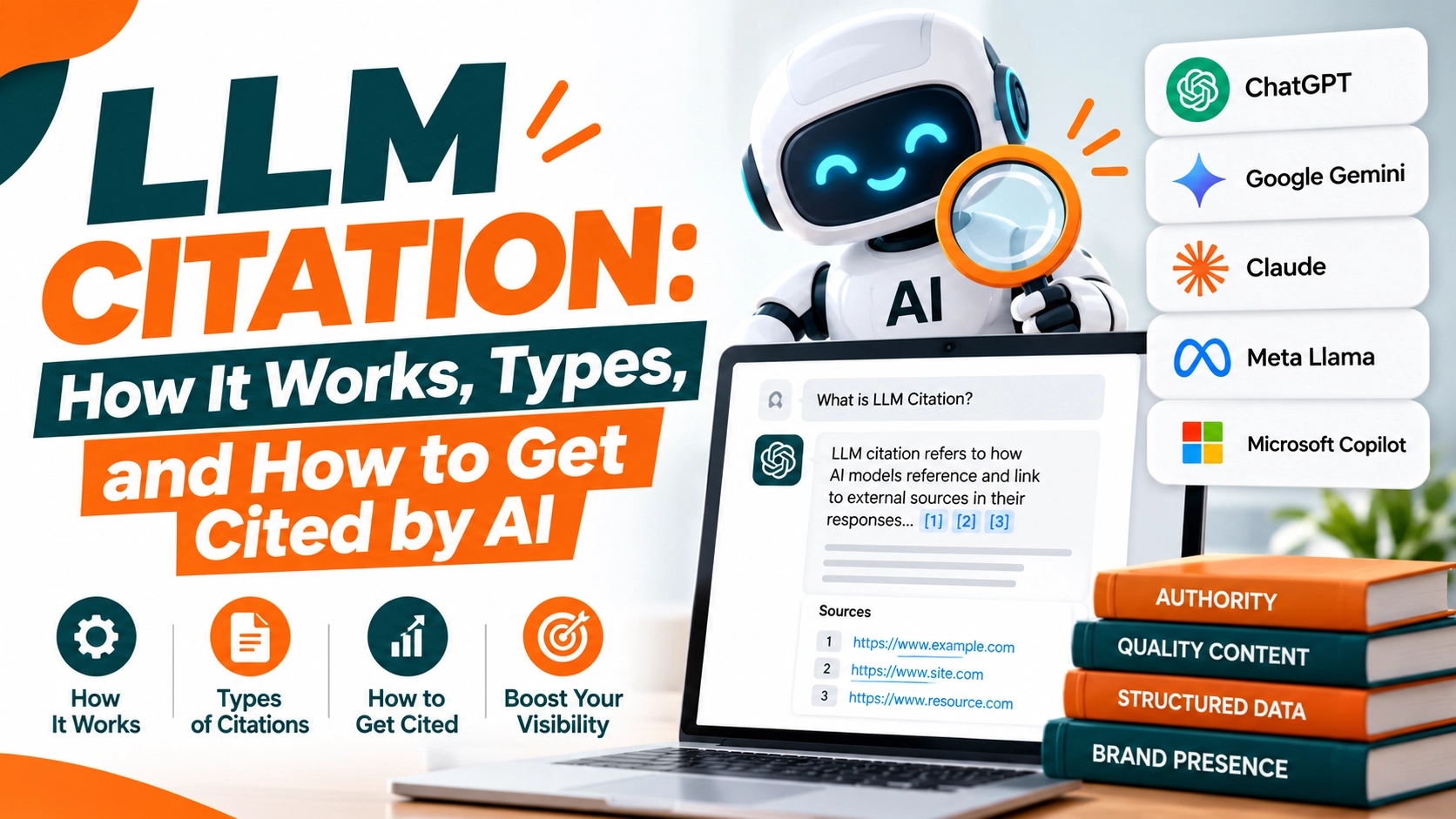
An LLM citation is a reference to a webpage or source used to support an AI-generated answer. Unlike SEO, which focuses on visibility in traditional search results, LLM citations can put your content directly in AI-generated answers.
For businesses, this means another opportunity to reach potential customers when they are actively looking for information, products, or services. This guide explains how LLM citations work, why they matter, and how to make content more likely to be cited.
What is an LLM Citation?
An LLM Citation is a reference to a webpage, document, or other identifiable source connected to information provided in an AI-generated answer. The way the reference appears depends on the platform. It might be a clickable webpage, a source card, a numbered reference, or another citation format.
For example, imagine someone asks an AI tool to compare accounting software for small businesses. The answer might use a software company’s website for pricing, a review website for customer feedback, and an industry publication for market information.
When those sources are identified alongside the information they support, they are functioning as citations. It is also important to distinguish an AI citation from other forms of online visibility:
| Signal | What it means |
| Brand mention | An AI response names your brand when answering a user’s question. |
| LLM citation | An AI response references your content as evidence or a source. |
| Google ranking | Your website competes for a position in Google’s organic results for a search query. |
These outcomes can overlap, but one does not guarantee another. A company can be mentioned without receiving a citation, while a particular page can be cited for a narrow question even if the brand is not highly visible everywhere else.
How Do LLM Citations Work?
An AI search system does not necessarily use every webpage it finds. When a person submits a question, the system can look for relevant information, assess potential sources, and use selected material while preparing the response.
For example, a question about CRM software might lead to product pages, comparison articles, customer reviews, and specialist websites. The final response may draw from several of them, while displaying only some as sources.
This creates an important distinction: a page can be found without becoming a citation.
The content still needs to be useful for the particular question. Information that is specific, understandable, current, and supported by evidence gives an AI system something concrete to work with.
There is no universal citation process shared by every AI platform. The systems differ in how they find information, select sources, generate answers, and display references.
Types of LLM Citations
Citations can come from different kinds of sources. For practical reporting, it is useful to separate them into a few categories.
| Type | What it means | Example |
| First-party citation | AI cites the brand’s own website | A software company’s pricing page is cited for current pricing |
| Third-party citation | AI cites an independent website about the brand | An industry publication is cited in a product comparison |
| Direct source citation | A specific source is attached to a particular claim | A research report is cited for a statistic |
These categories help distinguish where citations come from and make AI visibility reports easier to interpret.
What Makes a Page Worth Citing?
A page does not become useful as a source simply because it contains the right keyword. The information on the page needs to help answer the question being asked.
Here are some qualities worth focusing on:
- Direct answers: Give the reader the important information without making them search through unnecessary text.
- Specific details: Facts, figures, dates, comparisons, examples, and explanations are more useful than vague statements.
- Supporting evidence: Important claims should have information that allows them to be checked.
- Fresh information: Prices, product features, statistics, policies, and other changing details should be reviewed regularly.
- Original value: Research, firsthand observations, proprietary data, expert commentary, or useful comparisons can make a page more distinctive.
A simple test is to take one important section of your article and ask whether it could answer a customer’s question by itself.
If the answer is yes, you are already closer to creating information that can be reused in an AI response.
Why Does a Competitor Get Cited While You Don’t?
Seeing a competitor cited can be frustrating, particularly when your website already ranks well for related searches. But the reason may not be that the competitor has a stronger overall domain. Look at the exact page that was cited and compare it with yours.
Your competitor may have:
- answered the question more directly;
- included original research or data;
- provided a detail missing from your page;
- explained its product or service more clearly;
- updated important information more recently;
- received useful coverage from independent websites;
- kept important facts together on one page;
- presented company, product, and author information consistently.
Technical accessibility can also play a role. If important content cannot be reached by an AI search system, its quality cannot help with that particular query.
Instead of asking, “Why is this competitor ranking above us?”, ask:
“What does the cited page provide that our page does not?”
That comparison gives you specific improvements rather than another round of general SEO work.
How to Get Your Website Cited by AI
There is no setting you can switch on to guarantee citations. Your better option is to make your website a useful source for questions related to your subject.
Start with real questions
Find questions customers actually ask before creating content. Sales calls, customer emails, support conversations, search suggestions, forums, and existing website queries can all reveal useful topics.
Check what AI already says
Ask relevant questions on the AI platforms your audience uses. Note which companies appear, which pages are cited, and what information those sources provide. Look for gaps rather than simply copying the sources already appearing.
Add information competitors don’t have
If ten websites give the same basic explanation, publishing an eleventh version adds little. Consider adding original figures, examples, comparisons, expert opinions, research findings, case information, or practical instructions.
Make important information easy to find
Don’t hide your main answer beneath a long introduction. Put key facts in clear sections and use straightforward language.
Support important claims
If you publish statistics, dates, prices, research findings, or other factual information, give readers enough context to understand and verify the claim.
How to Make Existing Content More Citable
You do not always need to publish another article. Review pages that already receive traffic or support important products and services. Read each page from the perspective of someone who has arrived with one specific question.
Ask:
- Is the answer easy to find?
- Does the page contain specific information?
- Are important claims supported?
- Is the information still accurate?
- Does the page offer something competitors don’t?
Then improve the weakest areas.
For example, an article about website development costs could become more useful by showing realistic cost ranges, explaining what changes the price, comparing different development options, and listing what each package includes.
Adding useful information is more valuable than simply increasing the word count.
How to Track LLM Citations
Tracking AI visibility requires more than counting how often your company name appears. Create a simple record for your important queries:
| Query | AI platform | Brand mentioned | Cited | Cited URL | Competitor cited | Citation accurate |
| Best CRM for startups | ChatGPT | Yes | Yes | Your URL | Competitor A | Yes |
| CRM pricing comparison | Gemini | Yes | No | — | Competitor B | — |
| CRM features | Perplexity | No | No | — | Competitor A | — |
The “Citation accurate” column is particularly useful. A page being cited does not automatically mean it correctly supports what the AI has said.
For example, an AI system could cite your article while making a claim that your article never actually made. Recording this difference gives you a clearer picture of citation quality.
Run important queries more than once and review them periodically. AI responses can change, and the sources shown for the same question may not remain identical.
Does llms.txt Guarantee LLM Citations?
No. An llms.txt file should not be treated as a guaranteed way to get your website cited by AI systems. Technical guidance can be useful, but it cannot replace information that is accurate, accessible, well-organized, and genuinely useful. Your priority should remain the actual webpage: make important information available, keep it updated, explain subjects clearly, and provide enough evidence for significant claims.
Common LLM Citation Mistakes
Some common mistakes can weaken an AI-search strategy:
- Writing unnaturally for AI systems instead of people
- Repeating keywords simply to increase keyword frequency
- Treating every brand mention as a citation
- Publishing statistics without adequate support
- Making readers search through long introductions for basic answers
- Reproducing competitor content without adding new information
- Ignoring independent websites that discuss the brand
- Measuring mentions without recording the actual cited page
- Assuming one successful AI response means permanent visibility
The biggest mistake is treating AI citation as a writing trick.
There is no magic sentence structure that forces an AI system to select your page. Useful information gives you a much stronger foundation.
Wrapping Up
AI search is giving websites another way to reach people who are looking for information, products, and services. But trying to earn citations should not mean filling pages with keywords or copying the format of whatever competitor currently appears in an AI answer. The stronger approach is to understand what people want to know and publish information that gives them a clear reason to trust and use your page.
An LLM Citation can be a useful visibility signal, but it should be viewed as the result of creating valuable, accessible information rather than the only objective of your SEO strategy. Keep your content specific, accurate, current, and genuinely useful. That gives your audience a better experience while also giving AI systems stronger material to work with.
Frequently Asked Questions
Q. What is an LLM citation?
It is a reference that connects information in an AI-generated answer with a particular webpage or other identifiable source.
Q. How do LLM citations work?
An AI system may find several sources for a question, use information from some of them, and show selected sources with its final response.
Q. How do I get my brand cited by LLMs?
Create specific, accurate content that answers real questions and supports important information with useful evidence.
Q. How can I track LLM citations?
Test important queries across AI platforms and record brand mentions, cited pages, competitors, and whether each source actually supports the answer.
Q. Are LLM citations the same as backlinks?
No. A backlink connects two webpages, while an LLM citation identifies a source associated with information in an AI-generated answer.

Subash Kumar
Subash Kumar is a digital marketing strategist with over a decade of experience specializing in SEO, social media and data-driven content. He has helped brands achieve 150%+ growth in online visibility and increase engagement rates by up to 100% across technology, real state and ecommerce sectors. With a strong focus on analytics, Subash Kumar crafts campaigns that consistently drive results and deliver up to 5x ROI.