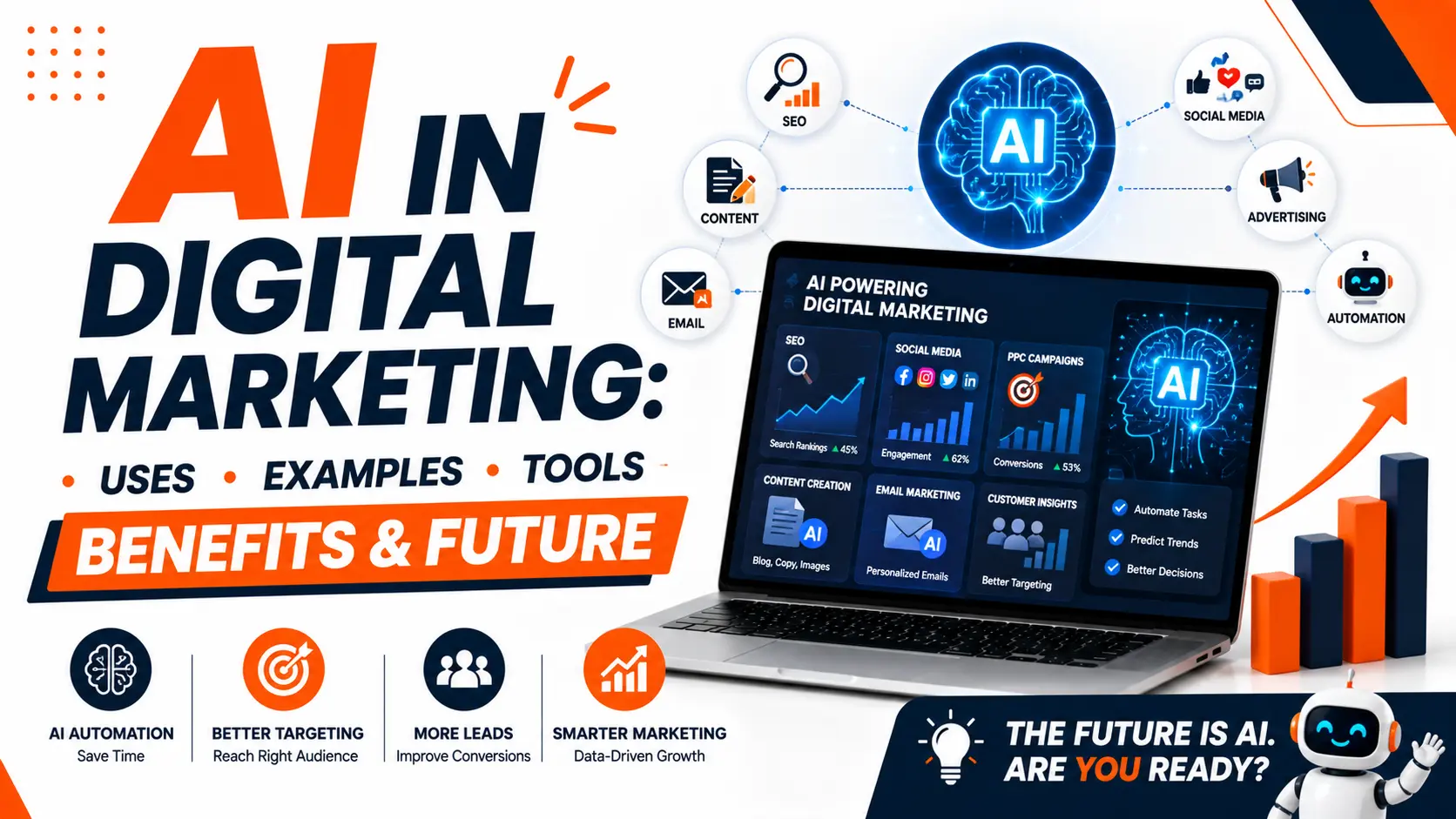
AI is no longer an experimental add-on for digital marketers—it is becoming part of the core marketing stack. Gartner’s 2026 CMO Spend Survey found that companies are allocating an average of 15.3% of their marketing budgets to AI initiatives, showing how quickly the technology is moving into mainstream marketing. From SEO and content creation to personalization, advertising, automation, and analytics, AI is changing how marketers work. But the real challenge is not simply adopting AI; it is knowing where it can create genuine value while keeping human creativity, expertise, and strategy at the center.
What Is AI in Digital Marketing?
AI in digital marketing refers to using artificial intelligence to make marketing tasks faster, smarter, and more efficient. It can help marketers understand customers, analyze data, create and optimize content, automate repetitive work, and improve campaign decisions.
By processing large amounts of data and recognizing patterns, AI can predict customer behavior, identify audience segments, personalize marketing messages, and recommend the next best action. This allows marketers to spend less time on repetitive tasks and more time on strategy, creativity, and customer relationships.
For marketers, this can mean:
- Researching customers and competitors
- Generating content ideas and drafts
- Finding keyword and SEO opportunities
- Optimizing advertising campaigns
- Personalizing emails and offers
- Analyzing campaign performance
- Automating marketing workflows
- Creating images and videos
- Answering customer questions through chatbots
Generative AI is the most visible part of this change. Tools can now create written copy, images, videos, campaign ideas, and other marketing assets from natural-language instructions.
However, AI in marketing goes much further than generative AI. Predictive analytics can help identify likely customer behavior. Recommendation systems can suggest products. Machine learning can help optimize advertising. AI-powered platforms can analyze customer interactions and personalize experiences.
This distinction matters because AI should not be treated as a replacement for marketing strategy. A tool can generate ten headlines in seconds, but it cannot decide which positioning best fits a brand’s audience without the right context and human judgment.
Why Is AI Becoming Important in Marketing?
Digital marketers now work across more channels while handling growing amounts of customer and campaign data. AI helps them analyze information faster, automate repetitive tasks, personalize customer experiences, and make better-informed decisions.
The investment reflects this shift. Gartner’s 2026 CMO Spend Survey found that CMOs are allocating an average of 15.3% of their marketing budgets to AI initiatives, although only 30% said their organizations were ready to scale AI capabilities.
AI is also changing search. Salesforce’s 2026 State of Marketing research found that 85% of marketers say AI is reshaping their SEO strategy, while 88% have started optimizing for AI-generated responses.
As a result, AI is becoming important not just for creating content, but for analyzing data, automating workflows, personalizing marketing, and adapting to changing search behavior.
Role of AI in Digital Marketing
AI is becoming part of the day-to-day marketing workflow, helping teams move from collecting information to acting on it faster. Its role varies across channels, but the core value is the same: AI handles data-heavy and repetitive work so marketers can spend more time on strategy, creativity, and decision-making.
1. Market Research
AI can scan customer reviews, surveys, social conversations, search trends, and competitor activity to uncover patterns that may be difficult to spot manually. Marketers can use these insights to understand customer needs, identify content opportunities, and find gaps in the market.
2. Content Marketing
AI can support almost the entire content workflow, from topic research and outlines to first drafts, headlines, content repurposing, and optimization. The marketer still needs to provide the expertise, brand perspective, facts, and final editorial judgment.
3. SEO and AI Search
AI makes SEO research faster by helping marketers discover keywords, analyze competitors, identify content gaps, and improve existing pages. Its role is also expanding as search becomes more conversational and AI-generated answers influence how users discover information and brands.
4. Paid Advertising
AI can analyze audience and campaign data to improve targeting, bidding, budget allocation, and creative testing. Instead of manually reviewing every variation, marketers can use AI to identify patterns and focus their attention on the campaigns that need strategic decisions.
5. Social Media
AI can help marketers generate content ideas, adapt posts for different platforms, analyze engagement, and identify audience trends. It can also support social listening by helping teams process large volumes of conversations and feedback.
6. Email and Personalization
AI can move email marketing beyond sending the same message to an entire list. It can help segment audiences, personalize content and offers, recommend products, and determine which customers are more likely to respond to a particular message.
7. Analytics and Automation
AI can turn large amounts of marketing data into easier-to-understand insights by identifying trends, anomalies, and potential opportunities. Combined with automation, it can also trigger actions such as follow-up emails, lead updates, reports, and customer journeys based on predefined conditions.
Examples of AI in Digital Marketing
AI is already being applied to practical marketing problems rather than existing only as an experimental technology. Some common examples include:
- AI content creation: Producing outlines, product descriptions, email drafts, and social copy.
- Personalized recommendations: Showing products or content based on customer behavior.
- AI chatbots: Answering questions and qualifying leads.
- Predictive advertising: Using data to improve targeting, bidding, and campaign decisions.
- AI-powered SEO: Finding keywords, content gaps, competitors, and optimization opportunities.
- Marketing automation: Triggering emails, CRM updates, and follow-up actions based on customer behavior.
- AI analytics: Finding patterns and changes in campaign or customer data.
- Generative design: Creating images and visual concepts for marketing campaigns.
Where marketers are actually spending this effort matters. A May 2025 NP Digital survey of 700 content marketers found 61% use AI specifically to help write blog content, the single highest-adoption use case in that study, with email copy a distant second at 44%. But CMI’s 2026 data above suggests content generation is exactly where the adoption-vs-impact gap is widest: plenty of teams are using AI to write, fewer are seeing it move the needle. That’s a signal to double-check where in your own funnel AI is earning its keep before scaling it further.
Best AI Tools for Digital Marketing
There is no single best AI marketing tool for every business. Some tools are designed for writing and research, while others focus on SEO, CRM, automation, email, social media, customer experience, creative production, or analytics.
| AI Tool | Best For | Main Use |
| ChatGPT | Content and strategy | Research, brainstorming, writing, analysis and repurposing |
| Claude | Long-form content | Writing, editing, document analysis and research |
| Writer | Enterprise content | AI writing, editing and brand-controlled content |
| Perplexity | Research | Web research and source discovery |
| Semrush | SEO and AI visibility | Keywords, competitors, content and AI-search tracking |
| Ahrefs | SEO research | Keywords, backlinks, competitors and content opportunities |
| Surfer SEO | Content optimization | On-page SEO and SERP-based content analysis |
| HubSpot | CRM and marketing | AI, CRM, automation, personalization and campaigns |
| Klaviyo | Email marketing | Segmentation, personalization and customer journeys |
| Optimove | Customer marketing | Customer data and personalized campaigns |
| Zapier | Workflow automation | Connecting apps and automating repetitive tasks |
| Manychat | Conversational marketing | Automated conversations across messaging channels |
| Buffer | Social media | Scheduling, publishing, analytics and content assistance |
| Canva | Marketing design | Graphics, presentations and AI-assisted creative |
| Midjourney | AI images | Generating visual concepts and marketing imagery |
| Adobe Firefly | Creative production | Generative images and creative editing |
| Lumen5 | Video content | Turning written content into video |
| Tableau | Marketing analytics | Data visualization and business insights |
| Mailchimp | Email marketing | Email automation, segmentation and campaign optimization |
1. ChatGPT

ChatGPT is a flexible AI assistant that can support research, campaign planning, content creation, analysis, brainstorming, and content repurposing.
Best for: Marketing teams looking for a general-purpose AI assistant.
2. Claude

Claude is useful for long-form writing, document analysis, editing, and research-heavy workflows.
Best for: Content teams working with large amounts of information.
3. Writer

Writer is designed for businesses that need AI-assisted content production while maintaining brand and editorial controls.
Best for: Enterprise content and marketing teams.
4. Perplexity

Perplexity is useful for research because it searches the web and presents answers alongside sources. Marketers can use it to investigate competitors, statistics, trends, products, and unfamiliar topics before creating content.
Best for: SEO professionals, writers, researchers, and strategists.
5. Semrush

Semrush provides tools for SEO, competitive research, content optimization, and AI-search visibility.
Best for: SEO teams, agencies, publishers, and businesses adapting to AI search.
6. Ahrefs

Ahrefs focuses on SEO research, including keyword analysis, backlink data, competitor research, and content opportunities.
Best for: SEO specialists, agencies, and content marketers.
7. Surfer SEO

Surfer SEO analyzes search results and helps marketers optimize content around topics covered by competing pages.
Best for: SEO writers, publishers, and content teams.
8. HubSpot
HubSpot combines CRM, marketing automation, customer data, and AI-powered marketing features. It can support lead management, campaigns, personalization, customer journeys, and automated workflows.
Best for: Businesses that want CRM and marketing operations connected in one platform.
9. Klaviyo
Klaviyo focuses on customer marketing, particularly email, ecommerce, segmentation, and automated campaigns.
Best for: Ecommerce brands and businesses focused heavily on retention and email marketing.
10. Optimove
Optimove uses customer data and AI-driven capabilities to help businesses segment audiences and create more personalized marketing campaigns.
Best for: Retail, ecommerce, and businesses managing complex customer journeys.
11. Zapier
Zapier connects different applications and automates workflows between them.
For example, a new lead can automatically enter a CRM, trigger an email, update a spreadsheet, and notify a sales representative.
Best for: Marketing operations and repetitive cross-platform processes.
12. Manychat

Manychat helps businesses automate conversations across social and messaging platforms. It can answer common questions, collect information, distribute content, and guide prospects toward a conversion.
Best for: Social media marketers, creators, ecommerce brands, and lead-generation campaigns.
13. Buffer

Buffer helps marketers plan, schedule, publish, and analyze social media content. Its AI features can also help generate and adapt social copy.
Best for: Small businesses, creators, agencies, and social media managers.
14. Canva

Canva helps marketers create social posts, presentations, graphics, and other visual assets. Its AI features can speed up ideation and creative production.
Best for: Small marketing teams and marketers who regularly produce visual content.
15. Midjourney

Midjourney generates images from natural-language prompts. It can be used to explore campaign concepts, creative directions, and visual ideas.
Best for: Creative teams, designers, and visual marketers.
16. Adobe Firefly
Adobe Firefly provides generative AI capabilities for creating and editing visual content.
Best for: Designers, creative teams, and businesses using Adobe’s creative ecosystem.
17. Lumen5

Lumen5 helps marketers turn written content into video assets.
Best for: Content teams looking to repurpose articles and other written material into video.
18. Tableau

Tableau helps businesses visualize complex datasets through dashboards and reports. Marketing teams can use it to analyze campaign performance, customer behavior, sales data, and other business metrics.
Best for: Data-driven marketing teams.
19. Mailchimp
Mailchimp combines email marketing, audience management, automation, segmentation, and AI-assisted capabilities.
Best for: Small businesses, ecommerce brands, and email marketing teams.
Pros and Cons of AI in Digital Marketing
AI can make marketing faster and more scalable, but it also comes with challenges that marketers need to manage carefully.
Pros
- Saves time: Automates repetitive tasks and reduces manual work.
- Improves productivity: Helps marketing teams accomplish more in less time.
- Enables personalization: Makes it easier to tailor content, offers, and campaigns to different audiences.
- Speeds up testing: Allows marketers to create and test more campaign variations.
- Handles large datasets: Processes customer and campaign data to uncover useful patterns and insights.
- Supports scalability: Helps smaller teams manage more marketing activities without significantly increasing their workload.
Cons
- Generic content: AI-generated material can lack originality, personality, and brand perspective.
- Factual errors: AI can produce inaccurate information, so important claims need human verification.
- Brand voice issues: Poorly guided AI output may sound inconsistent with a brand’s tone and identity.
- Privacy concerns: Using customer data with AI requires careful attention to privacy and data protection.
- Over-automation: Excessive automation can make customer interactions feel impersonal or robotic.
- Uncertain ROI: Using AI does not automatically lead to better results; businesses still need to measure its actual impact.
Content Marketing Institute’s 2026 B2B research illustrates the quality challenge. Although 9 in 10 B2B marketers use AI to produce content, fewer than 4 in 10 say it has actually improved performance. That is an important distinction. AI adoption is not the same thing as AI effectiveness.
How to Use AI in Digital Marketing
The best way to introduce AI is to begin with a marketing problem rather than a particular tool.
- Identify Repetitive Tasks: Look for activities that consume time without requiring much strategic judgment, such as summarizing reports, generating variations, organizing information, or transferring data between platforms.
- Select the Right Tool: Choose a platform based on the job. An SEO platform makes more sense for keyword research, while a CRM or automation platform is better suited to customer journeys.
- Give AI Enough Context: Include information about your audience, product, brand voice, campaign objective, market, and desired outcome.
- Keep Human Review in the Workflow: Check AI-generated claims, recommendations, creative work, and customer-facing content before publication or deployment.
- Measure the Result: Track a meaningful outcome such as conversion rate, cost per lead, organic traffic, email revenue, engagement, or hours saved.
- Scale Successful Workflows: If one AI workflow produces measurable value, expand it carefully into other marketing processes.
The advantage increasingly comes not from having access to AI, but from knowing exactly where to deploy it and having the discipline to walk away from uses that aren’t paying off.
Will AI Replace Digital Marketers?
AI is more likely to automate individual marketing tasks than eliminate digital marketing as a profession.
AI can generate drafts, analyze information, recognize patterns, create variations, and automate workflows. Human marketers are still needed for positioning, strategy, creativity, customer understanding, brand decisions, and accountability.
Adobe and Oxford Economics’ research highlights the importance of organizational readiness, connected data, and customer trust as businesses expand their use of AI.
This means the marketer’s role may change rather than disappear.
Instead of spending hours on repetitive production, marketers may spend more time directing AI systems, checking outputs, interpreting data, developing strategy, conducting original research, and making creative decisions.
The valuable skill will not simply be knowing how to use ChatGPT or another AI tool. It will be knowing when to use AI, what to ask it to do, and when human judgment should take over.
The Future of AI in Digital Marketing
AI has already changed how digital marketing is planned and executed. Tasks that once required hours of manual research, content production, audience analysis, and campaign optimization can now be completed much faster. It has also changed customer discovery, with AI-generated answers becoming another place where brands need to be visible.
The next stage will be a shift from AI assisting marketers to AI managing more connected workflows. Gartner expects AI-driven automation of marketing work to rise from 16% in 2026 to 36% by 2028, while 60% of brands are expected to use agentic AI for one-to-one customer interactions by 2028.
This will make real-time personalization, automated decision-making, AI-powered search, and conversational customer experiences more common. At the same time, marketers will need stronger data, brand controls, and human oversight. As producing basic content becomes easier, original expertise, creativity, strategy, and trust will become more important differentiators.
Conclusion
AI is becoming a core part of digital marketing, from customer research and content creation to SEO, personalization, automation, and analytics. But the strongest marketing strategy is not the one using the most AI tools. It is the one using AI where it creates measurable value while keeping human expertise in control.
As AI search, automation, personalization, and analytics continue to develop, marketers who combine technology with original thinking, reliable data, creativity, and customer understanding will be better positioned to compete. AI can make marketing faster and more scalable, but strategy, judgment, and genuine expertise will continue to determine whether those efforts actually work.
FAQs
Q. What is AI in digital marketing?
AI in digital marketing is the use of artificial intelligence to automate tasks, analyze data, understand customer behavior, personalize experiences, and improve marketing decisions.
Q. How is AI used in digital marketing?
AI is used for content creation, SEO, customer research, advertising, email marketing, personalization, chatbots, social media, analytics, and marketing automation.
Q. What are the benefits of AI in digital marketing?
AI can save time, reduce repetitive work, process large amounts of data, improve personalization, speed up content production, and help marketers make faster data-driven decisions.
Q. What are the best AI tools for digital marketing?
Popular AI marketing tools include ChatGPT, Claude, Perplexity, Semrush, Ahrefs, Surfer SEO, HubSpot, Canva, Klaviyo, Buffer, and Mailchimp. The right tool depends on the marketing task you want to improve.
Q. Will AI replace digital marketers?
AI is unlikely to replace digital marketers completely. It can automate many repetitive tasks, but human skills such as strategy, creativity, critical thinking, customer understanding, and brand decision-making remain important.

Subash Kumar
Subash Kumar is a digital marketing strategist with over a decade of experience specializing in SEO, social media and data-driven content. He has helped brands achieve 150%+ growth in online visibility and increase engagement rates by up to 100% across technology, real state and ecommerce sectors. With a strong focus on analytics, Subash Kumar crafts campaigns that consistently drive results and deliver up to 5x ROI.