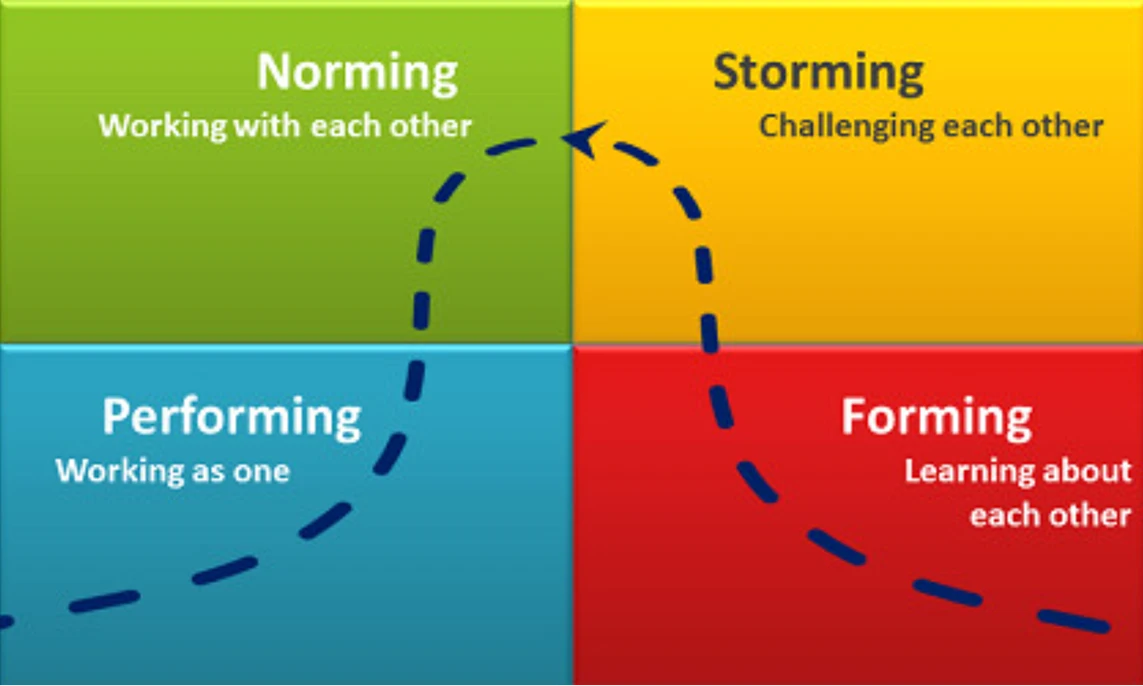
Building a successful team requires time, effort, and an understanding of team dynamics. Teams go through different stages of development before they can function effectively. Knowing these stages helps leaders and team members navigate challenges, improve communication, and enhance efficiency.
In today’s fast-paced project environments, understanding team development isn’t just theory; it’s a practical tool to improve collaboration, meet deadlines, and achieve project success. Leaders who recognize each stage can preempt challenges and guide teams more effectively.
Understanding team development has real-world applications in project management. Leaders can use Tuckman’s stages to plan milestones, allocate resources efficiently, and improve team productivity. Applying these stages proactively can help meet deadlines, prevent bottlenecks, and ensure successful project outcomes.
Tuckman’s Four Stages of Team Development
In 1965, psychologist Bruce Tuckman introduced a model outlining four stages of team development: Forming, Storming, Norming, and Performing. In 1977, he added a fifth stage, Adjourning, to address team dissolution or transition. This model explains how teams mature, highlighting unique challenges and leadership needs at each phase.
By applying Tuckman’s model, teams can resolve conflicts, clarify roles, and achieve shared goals, whether in a corporate project, a school group, or a community initiative.
Summary of Tuckman’s Stages
| Stage | Characteristics | Challenges | Leader’s Role |
| Forming | Politeness, uncertainty, reliance on leader | Role clarity, trust-building | Set goals, facilitate bonding, provide structure |
| Storming | Conflicts, power struggles, differing opinions | Conflict resolution, maintaining motivation | Mediate disputes, promote psychological safety |
| Norming | Trust, collaboration, clear norms | Sustaining cohesion, preventing old conflicts | Reinforce norms, encourage teamwork |
| Performing | High productivity, autonomy, innovation | Sustaining momentum, avoiding complacency | Empower team, foster growth |
| Adjourning | Completion, reflection, transition | Emotional closure, preparing for change | Celebrate achievements, support transitions |
1. Forming (The Orientation Stage)
The Forming stage is the team’s starting point, where members meet, establish initial impressions, and explore their roles. Excitement mixes with uncertainty as individuals seek clarity and connection, whether in a corporate task force, a classroom project group, or a volunteer committee.
Characteristics:
- Polite and cautious interactions as members aim to fit in.
- Uncertainty about roles, goals, and team dynamics.
- Heavy reliance on the leader for guidance.
- Formal communication with minimal conflict.
Key Challenges:
- Unclear roles: Members may struggle to understand their responsibilities.
- Building connections: Trust is low as relationships are new.
- Low efficiency: Productivity lags as the team learns to collaborate.
- Ensuring early alignment on project objectives and timelines prevents confusion and delays later. Teams that clarify responsibilities upfront are 30% more likely to meet project goals on time (HBR, 2017).
Leader’s Role:
- Set clear expectations: Define goals, roles, and timelines (e.g., create a team charter).
- Facilitate bonding: Use icebreakers, like a “two truths and one lie” activity, to build rapport.
- Provide structure: Share agendas and schedules to reduce uncertainty.
- Encourage questions: Create a safe space for members to seek clarification
- Connect tasks to project outcomes: Show how each member’s role contributes to overall team success.
Example:
A newly formed marketing team might hold a kickoff meeting where the leader outlines the campaign goal, assigns initial roles, and uses a team-building exercise to help members connect.
Supporting Facts:
- Tuckman’s 1965 model emphasizes the need for structure in early team formation.
- MIT’s Human Dynamics Laboratory found that teams with clear leadership in the Forming stage are 20% more likely to succeed long-term.
- A 2017 Harvard Business Review study noted that teams with defined goals early on achieve 30% higher success rates.
For Leaders:
- Clarify roles and responsibilities immediately.
- Align team goals with project milestones.
- Use icebreakers or team-building exercises to boost early engagement.
For Team Members:
- Ask questions to clarify expectations.
- Share personal strengths to help assign tasks effectively.
- Build early rapport with teammates.
2. Storming (The Conflict Stage)
The Storming stage brings challenges as members grow comfortable and express differing opinions. Conflicts may arise over ideas, work styles, or leadership, testing the team’s ability to collaborate. This phase is critical for growth, whether in a startup, a student group, or a community organization.
Characteristics:
- Disagreements surface as members assert their perspectives.
- Power dynamics emerge as individuals vie for influence.
- Productivity may dip due to tension or unresolved issues.
- Some members may disengage if they feel unheard.
- Differences in work styles and decision-making approaches often emerge, particularly in project-driven environments where stakes are high.
Key Challenges:
- Resolving conflicts: Disagreements must be addressed constructively.
- Decision-making hurdles: Diverse opinions can stall progress.
- Maintaining engagement: Frustration may lead to withdrawal.
Leader’s Role:
- Promote psychological safety: Ensure members feel safe sharing ideas without judgment.
- Mediate disputes: Use frameworks like “active listening” to resolve conflicts.
- Clarify roles: Revisit the team charter to align expectations.
- Focus on shared goals: Remind the team of their common purpose.
- Use structured decision-making tools or frameworks to turn disagreements into innovative solutions.
Example:
In a school project team, students might clash over the project’s direction. The leader (e.g., a teacher or group captain) could facilitate a discussion to align on a shared vision, using a brainstorming session to integrate ideas.
Supporting Facts:
- Google’s Project Aristotle (2016) found that psychological safety is the top factor in high-performing teams.
- A Journal of Organizational Behavior study showed that teams addressing conflicts early are 25% more productive.
- Teams that resolve conflicts early during high-pressure projects report 25% higher efficiency (Journal of Organizational Behavior).
- Harvard Business Review (2017) noted that constructive conflict resolution leads to long-term team success.
For Leaders:
- Mediate conflicts quickly and fairly.
- Encourage open discussions and diverse perspectives.
For Team Members:
- Listen actively to colleagues.
- Find common ground and focus on shared goals.
3. Norming (The Cohesion Stage)
The Norming stage is a turning point where the team builds trust and collaboration. Conflicts from Storming are resolved, and members align on shared norms, whether in a corporate department, a sports team, or a volunteer group.
Characteristics:
- Clear acceptance of roles and responsibilities.
- Increased trust, respect, and open communication.
- Stronger focus on shared goals over individual differences.
- Productivity rises as collaboration improves.
- Teams begin to establish shared processes and workflow standards, which is critical for consistent project delivery.
Key Challenges:
- Sustaining cohesion: Preventing old conflicts from resurfacing.
- Reinforcing norms: Maintaining consistent processes, like regular check-ins.
Leader’s Role:
- Strengthen bonds: Organize team-building activities, like a shared lunch or virtual coffee chat.
- Reinforce norms: Establish routines, such as weekly progress meetings.
- Recognize contributions: Acknowledge individual and team successes to boost morale.
- Grant autonomy: Allow members to take ownership while providing support.
- Promote project-specific best practices and checklists to ensure everyone follows agreed-upon norms, improving efficiency and reducing errors.
Example:
A community volunteer team organizing a fundraiser might establish norms like weekly updates via a shared document and celebrate small wins, like securing a venue, to maintain momentum.
Supporting Facts:
- Gallup (2020) found that teams with strong relationships are 21% more productive.
- Katzenbach and Smith (1993) noted that shared purpose and trust drive team effectiveness.
For Leaders:
- Reinforce positive behaviors.
- Encourage collaborative problem-solving.
For Team Members:
- Support colleagues and maintain trust.
- Follow established processes for smooth collaboration.
4. Performing (The Productivity Stage)
In the Performing stage, the team operates at peak efficiency, with high trust and seamless collaboration. Members proactively solve problems and innovate, whether delivering a corporate project, winning a sports championship, or launching a community initiative.
Characteristics:
- High trust, motivation, and autonomy.
- Smooth decision-making with minimal conflict.
- Strong focus on achieving results and innovation.
- Members balance independence with teamwork.
- High-performing teams often anticipate challenges and adapt workflows proactively, making them well-suited for complex projects.
Key Challenges:
- Sustaining momentum: Avoiding burnout or complacency.
- Encouraging growth: Continuously seeking improvement.
Leader’s Role:
- Empower the team: Delegate decision-making to foster ownership.
- Promote innovation: Introduce tools like agile sprints or brainstorming sessions.
- Encourage project innovation sessions and continuous improvement initiatives, linking team achievements to measurable project outcomes.
- Celebrate achievements: Recognize milestones to maintain morale.
- Provide growth opportunities: Offer training or new challenges.
Example:
A software development team in the Performing stage might use agile methodologies, like daily stand-ups, to deliver a product efficiently, with members mentoring each other to enhance skills.
Supporting Facts:
- McKinsey & Company (2021) found that high-performing teams are 1.9 times more likely to achieve above-average results.
- A Harvard Business Review study (2019) noted that innovative teams outperform competitors by 30%.
- Lencioni (2002) highlighted that trust and accountability drive superior performance.
For Leaders:
- Recognize achievements regularly.
- Promote continuous learning and skill development.
For Team Members:
- Take ownership of tasks.
- Mentor and support teammates.
5. Adjourning (The Transition Stage)
The Adjourning stage, added by Tuckman in 1977, occurs when a team completes its goal or disbands. Members reflect on achievements and prepare for transitions, which can be emotional, whether in a project team, a graduating class, or a volunteer group.
Characteristics:
- Sense of accomplishment mixed with bittersweet emotions.
- Reflection on individual and team growth.
- Preparation for new roles or team changes.
- Potential anxiety about future uncertainties.
- Reflection is especially valuable in project-based teams, as it informs future project planning and team formation.
Key Challenges:
- Emotional closure: Managing feelings of loss or uncertainty.
- Transition planning: Ensuring members are prepared for what’s next.
Leader’s Role:
- Celebrate successes: Host a wrap-up event or share a team retrospective.
- Support transitions: Provide guidance on next steps, like new projects or roles.
- Facilitate reflection: Use tools like a “lessons learned” session to capture insights.
- Document lessons learned and create a transition guide for team members moving to new projects.
- Maintain connections: Encourage ongoing networking or mentorship.
Example:
A project team completing a product launch might hold a celebration event, share lessons learned in a retrospective, and discuss future opportunities to maintain team connections.
Supporting Facts:
- Tuckman and Jensen (1977) emphasized the importance of closure for team morale.
- A 2018 study by the Academy of Management found that teams with formal closure activities report higher satisfaction.
Importance of Tuckman’s Model
Tuckman’s model provides a roadmap for managing teams effectively, anticipating challenges, and fostering collaboration across contexts like workplaces, schools, or community groups.
Applications:
- Project Teams: Clarifies roles and resolves conflicts for efficient delivery.
- Leadership Development: Equips managers to guide teams through transitions.
- Remote/Hybrid Teams: Builds trust and communication despite distance.
- Supports remote and hybrid teams by clarifying expectations, virtual communication norms, and collaboration methods.
- Helps project managers anticipate bottlenecks and assign resources effectively.
Key Benefits:
- ✅ Faster integration through clear expectations.
- ✅ Proactive conflict resolution for stronger cohesion.
- ✅ Higher productivity as teams reach the Performing stage.
- ✅ Ensures teams stay aligned with project milestones, increasing on-time delivery.
- ✅ Reduces project delays by identifying conflict and inefficiency early.
- ✅ Enhanced engagement and satisfaction across team types.
Strategies to Navigate Each Stage Effectively
For Leaders:
- Forming: Set clear goals, facilitate introductions, and establish direction.
- Storming: Mediate conflicts and encourage open discussions.
- Norming: Reinforce positive behaviors and promote teamwork.
- Performing: Recognize achievements and encourage continuous learning.
- Adjourning: Celebrate successes and support transitions.
For Team Members:
- Forming: Build relationships and clarify expectations.
- Storming: Respect different perspectives and find common ground.
- Norming: Support colleagues and maintain trust.
- Performing: Take ownership of tasks and mentor others.
- Adjourning: Reflect on experiences and apply lessons to new projects.
Decision-Making & Innovation Tools
- Use frameworks like RACI charts or prioritization matrices to improve decision-making.
- Apply agile sprints, retrospectives, and innovation sessions to anticipate challenges and improve performance.
Metrics & Outcomes
- Track KPIs such as task completion rate, milestone achievement, and innovation output to assess team effectiveness.
- Teams that clarify roles and resolve conflicts early can see 25–30% improvement in project success rates.
Conclusion
Tuckman’s Forming, Storming, Norming, Performing, and Adjourning model is a powerful framework for building successful teams. By recognizing their current stage and applying tailored strategies, leaders and members can navigate challenges, foster trust, and unlock peak performance—whether in a corporate office, a classroom, or a community project. Assess