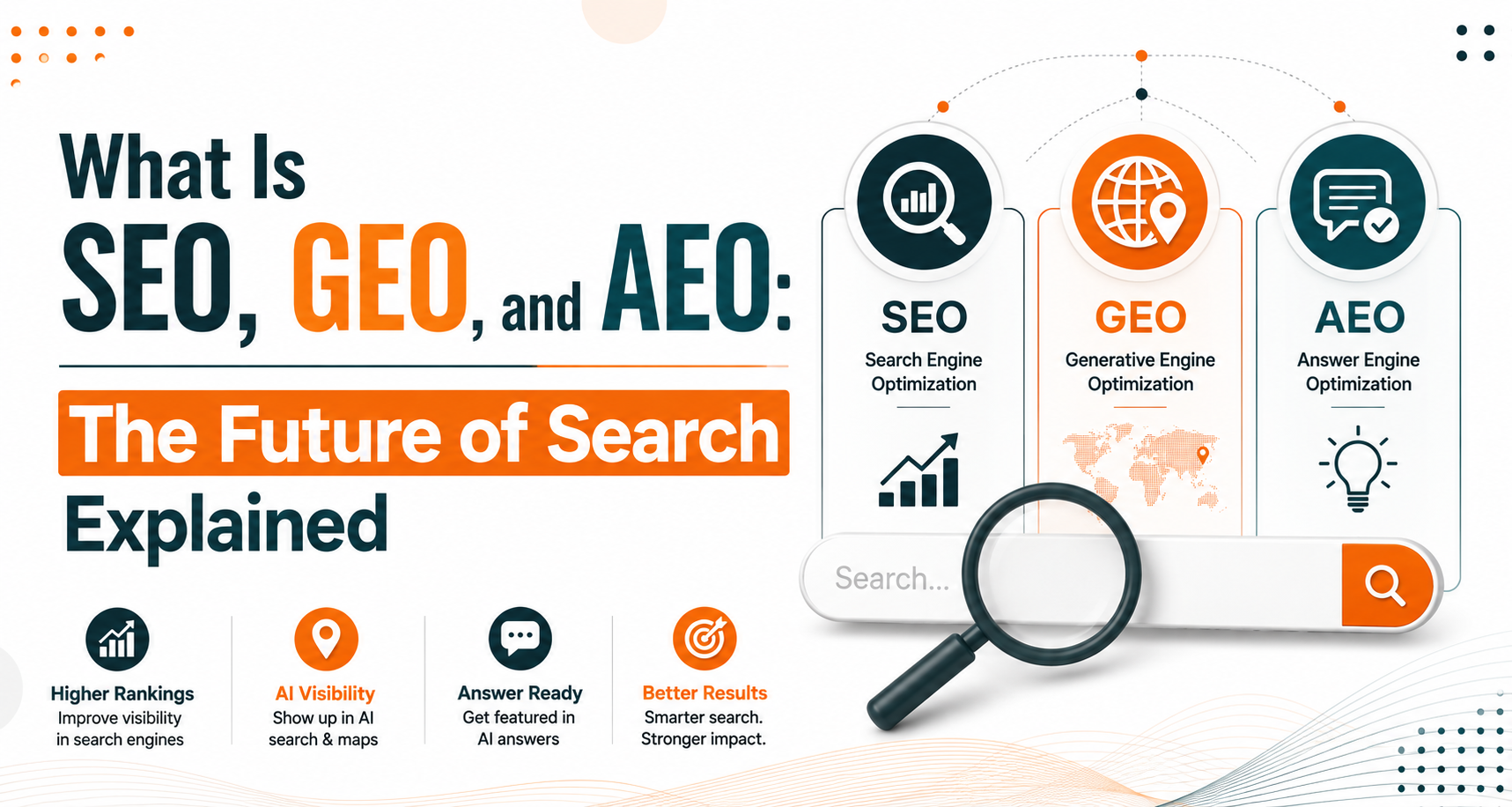
Search behavior has changed dramatically in recent years as users now expect instant and direct answers instead of browsing multiple websites. Earlier, people relied heavily on search engines like Google, where they entered queries, clicked links, and read full articles to find information. That model is now evolving due to faster internet access, mobile-first usage, and AI-driven tools like ChatGPT, Gemini, and Perplexity.
According to SparkToro research, more than 60% of Google searches now end without a click, meaning users often get answers directly on the search results page. At the same time, AI adoption is rapidly increasing, changing how information is discovered.
This shift has created a new digital reality where visibility is no longer limited to Google rankings. Content must now perform across search engines, answer engines, and AI systems. This is exactly where understanding what is SEO GEO and AEO becomes important for modern digital growth.
The Evolution of Search: From Links to AI Answers
Search engines have evolved in a very clear direction over time, and each stage has completely changed how users interact with information online. In the beginning, search engines functioned mainly as directories where users had to manually browse multiple websites to find answers. For example, if someone searches “height of Mount Everest,” Google now directly shows the answer at the top of the page instead of requiring users to open any article. This made the search faster and more convenient for users.
Now, we are in the third stage of search evolution, driven by artificial intelligence. Instead of only showing links or short answers, AI tools like ChatGPT, Gemini, and Perplexity generate full explanations in a conversational format. For example, if you ask “What is SEO, AEO, and GEO?”, AI systems provide a complete, structured explanation in one response without needing you to visit any website.
This evolution clearly shows how search has moved from browsing multiple pages to receiving instant answers and now to full AI-generated knowledge. Each stage has made information access faster, simpler, and more personalized for users.
What is SEO (Search Engine Optimization)?
SEO is the process of improving a website so that it appears in search engine results when users search for relevant topics. It is the foundation of online visibility because without SEO, even high-quality content may never be discovered.
For example, if you write a blog on “best budget laptops for students,” SEO helps your article appear when someone searches that exact or related query on Google. Without SEO, your content would remain invisible even if it contains valuable information.
SEO is important because search engines process billions of queries every day, and users mostly click on results shown on the first page. Studies show that the top result alone receives a major share of total clicks, while lower-ranking pages get significantly less traffic.
Core SEO Strategies
SEO is built on three main pillars, and each one plays a different role in improving visibility.
- Technical SEO: Technical SEO ensures that your website works properly for both users and search engines. A slow, broken, or poorly structured website can negatively impact rankings even if the content is good. For example, if your website takes too long to load, users may leave quickly, which can reduce rankings. Similarly, a non-mobile-friendly website may lose traffic because most users browse on mobile devices.
- On-Page SEO: On-page SEO focuses on optimizing content elements like titles, headings, structure, and keywords so search engines can understand the page better. For example, if your topic is “digital marketing,” your content should clearly explain its key areas like SEO, social media, and email marketing. This helps search engines understand the full context of your page.
- Off-Page SEO: Off-page SEO builds authority outside your website through backlinks and brand mentions. For example, when a trusted website links to your content, search engines consider it more reliable and may rank it higher. It works like reputation—more recommendations mean higher trust.
What is AEO (Answer Engine Optimization)?
AEO, or Answer Engine Optimization, is the process of structuring and optimizing content so that search engines can directly extract clear answers and display them instantly on the results page. Instead of only ranking websites as clickable links, search engines now aim to provide users with immediate information without requiring them to visit multiple pages.
For example, when someone searches “What is SEO?”, Google often shows a short, direct definition at the top of the search results. This allows users to understand the answer quickly without opening any website, saving time and improving the overall search experience.
AEO has become increasingly important because user behavior has changed. People now prefer fast, direct, and easy-to-understand answers, especially on mobile devices where convenience and speed matter more than browsing long articles.
Core AEO Strategies
AEO is mainly about structuring content so search engines can quickly understand and extract answers.
- Direct Answers First: Always start with a clear definition or answer instead of a long introduction. For example, instead of writing a long paragraph first, you can directly say: “SEO is the process of improving a website’s visibility on search engines like Google.”
- Question-Based Structure: Content should be written in a way that matches how users search. For example:
- What is SEO?
- How does SEO work?
- Why is SEO important?
This structure increases the chances of your content appearing in featured snippets.
- Simple and Clear Language: AEO prefers simple explanations that anyone can understand. For example: Instead of saying “SEO is a multifaceted optimization methodology,” it is better to say “SEO helps your website appear in Google search results.”
- Voice Search Optimization: Many users now use voice assistants like Siri or Google Assistant. These users speak in natural sentences. For example, instead of typing “weather Delhi,” they ask, “What is the weather in Delhi today?” So content should be written in a natural speaking style.
- Implement Schema Markup: Schema markup helps search engines better understand the structure and meaning of your content. It provides additional context about your page, such as FAQs, definitions, or article type. This structured data improves how search engines interpret your content and increases the chances of appearing in rich results, featured snippets, and other enhanced search features.
What is GEO (Generative Engine Optimization)?
GEO, or Generative Engine Optimization, is the process of optimizing content so that AI systems can clearly understand it, learn from it, and use it while generating responses for users. It focuses on making content AI-friendly so that it can be included in answers created by tools like ChatGPT, Gemini, and other generative search systems.
Unlike traditional search engines that show a list of websites for users to click, AI-powered tools work differently. They do not simply display links. Instead, they analyze information from multiple sources, understand the context, and then generate a complete, summarized answer in a conversational format.
For example, if you ask an AI tool, “Explain SEO, AEO, and GEO,” it will not show different websites. Instead, it will combine relevant information and provide a single, well-structured explanation in one response. This is exactly why GEO is becoming important—it ensures that your content is easy for AI systems to interpret and include in these generated answers.
Core GEO Strategies
GEO focuses on making content useful for AI systems that generate answers.
- Create and Optimize Entities: Clearly define your brand, product, or expertise so AI systems can correctly identify what you represent. Use consistent names, descriptions, and references across your website and external platforms. This helps AI systems connect your entity with relevant topics and improves visibility in AI-generated responses.
- Create High-Quality, Authoritative Content: Publish content that shows expertise, accuracy, and original thinking. AI systems prefer reliable and well-researched information because they depend on trusted sources when generating answers. Strong authority increases the chances of your content being included in AI outputs.
- Organize Content Clearly: Maintain a clean structure with logical sections and smooth flow. Proper headings, subheadings, and internal linking help AI systems understand relationships between ideas. It also improves readability for users, making content easier to navigate.
- Build Topic Authority: Focus on consistently creating content around specific themes or niches. When you publish regularly on the same subject, AI systems recognize your site as an authority in that area. For example, covering digital marketing topics repeatedly strengthens topical authority.
- Ensure Originality and Usefulness: Avoid repetitive or generic content. AI systems prioritize unique insights, real examples, and useful information. Original content has a higher chance of being selected for AI-generated responses.
SEO vs AEO vs GEO: Key Differences Explained
SEO, AEO, and GEO are all important parts of modern search visibility, but each one works in a different way and serves a different purpose. SEO focuses on ranking websites in traditional search results, AEO focuses on providing direct answers on search engines, and GEO focuses on making content usable for AI-generated responses.
Understanding the difference between them helps businesses and content creators build a complete digital strategy that works across Google, voice search, and AI platforms.
| Feature | SEO (Search Engine Optimization) | AEO (Answer Engine Optimization) | GEO (Generative Engine Optimization) |
| Main Goal | Improve website ranking on search engines | Provide direct answers in search results | Make content usable for AI-generated responses |
| Where It Works | Google, Bing, Yahoo | Featured snippets, voice search, “People Also Ask” | AI tools like ChatGPT, Gemini, Perplexity |
| Content Focus | Keywords, backlinks, page optimization | Clear and direct answers | Context-rich, structured, AI-readable content |
| User Experience | Users click and read websites | Users get instant answers without clicking | Users receive AI-generated explanations |
| Content Style | Long-form SEO content | Short, clear, structured answers | Human-like, contextual, well-explained content |
| Traffic Type | Organic website traffic | Zero-click search results | AI visibility and brand mentions |
| Key Requirement | Authority, relevance, backlinks | Clarity, structure, direct answers | Accuracy, context, entity understanding |
| Example Use Case | Ranking a blog on Google | Showing definition in featured snippet | Being cited in AI-generated answers |
Search Everywhere Optimization: Visibility Across All Digital Platforms
Search Everywhere Optimization is the process of optimizing content so it can be discovered across every platform where people search for information, not just Google. Today, users don’t rely on a single search engine—they find answers through AI tools, voice assistants, social media platforms, video apps, and traditional search engines.
In simple terms, it means making your content visible everywhere users look for answers. Instead of focusing only on Google rankings, the goal is to ensure your content can appear in search results, featured snippets, AI-generated responses, voice search answers, and platforms like YouTube, Instagram, and LinkedIn.
For example, a query like “best digital marketing tips” may show blog posts on Google, videos on YouTube, and even quick answers from AI tools. With proper optimization, your content can be present across all these platforms, increasing reach and visibility.
Today, users don’t rely on just one platform. That’s why optimizing for what is SEO GEO and AEO across multiple channels increases visibility everywhere.
How to Do Search Everywhere Optimization (Practical Steps That Actually Matter)
Search Everywhere Optimization only works when your content is built on trust, structure, authority, and multi-platform visibility. These steps combine SEO, AEO, GEO, and E-E-A-T principles so your content performs across Google, AI tools, voice search, and social platforms.
Step 1: Build E-E-A-T First (Experience, Expertise, Authority, Trust)
Start by ensuring your content has strong E-E-A-T signals because this is what both Google and AI systems rely on to judge quality. Add real expertise, explain concepts from experience, use accurate information, and maintain consistency across your website. If possible, include author details, real insights, case examples, and trustworthy references so your content is seen as credible.
Step 2: Create Structured, Intent-Based Content (SEO + AEO Foundation)
Write content that directly matches user intent. Use clear headings, answer-based sections, and simple explanations. Every section should answer a real search query like “what is,” “how to,” or “why it matters.” This improves your chances of ranking on Google, appearing in featured snippets, and being used in voice search results.
Step 3: Optimize for AI Understanding (GEO + Entity Signals)
Make your content machine-readable by clearly defining entities such as your brand, topic, or expertise. Use consistent terminology, structured explanations, and context-rich writing. AI systems like ChatGPT and Gemini rely on clarity, entity recognition, and contextual depth to decide what content to use in generated answers.
Step 4: Distribute Content Across Search Everywhere Channels
Do not rely only on Google. Publish and adapt your content for YouTube, LinkedIn, Instagram, and other discovery platforms. Break long-form content into short insights, videos, carousels, and summaries. This ensures your content appears wherever users search, not just in traditional search engines.
Step 5: Strengthen Topical Authority Through Consistency
Search engines and AI systems trust websites that consistently publish content around a specific niche. Focus on building clusters of related topics instead of random content. Over time, this signals strong topical authority, which improves rankings, AI visibility, and brand recognition across all search platforms.
Step 6: Ensure Content is Verifiable, Original, and Experience-Based
Avoid generic or rewritten content. Add real examples, insights, or data wherever possible. AI systems and search engines prioritize original, experience-based content that adds value instead of repeating existing information. This is one of the strongest signals for long-term visibility in both SEO and GEO.
Conclusion
Understanding what is SEO, GEO and AEO is important in today’s digital world where search is evolving beyond traditional Google results. SEO helps websites rank on search engines, AEO focuses on delivering direct answers through featured snippets and voice search, and GEO ensures content is optimized for AI systems like ChatGPT and Gemini. Together, they define the future of online visibility across search engines, answer engines, and AI platforms. Businesses that adapt to all three strategies can reach users at every stage of search, improve visibility, and stay relevant in an AI-driven search ecosystem where fast, accurate, and clear information matters most.