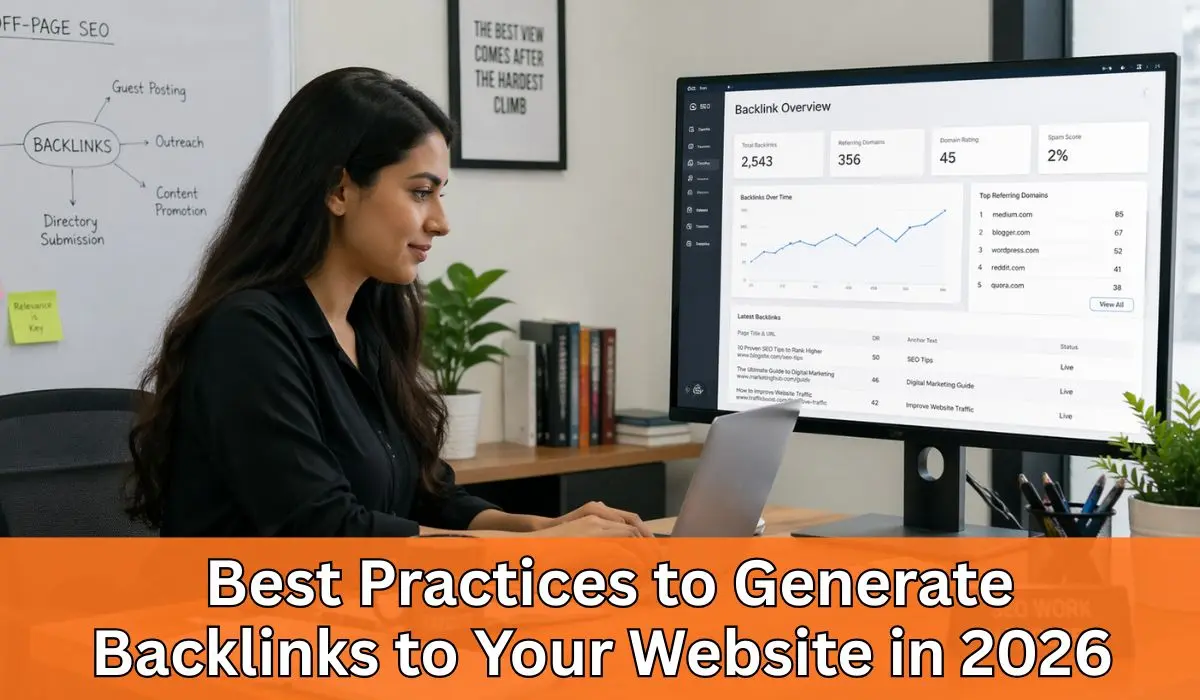
Backlinks are links from one website to another, and they act as signals that help search engines understand the value and trustworthiness of your content. When multiple websites link to your page, it indicates that your information is useful and relevant.
In 2026, backlinks are no longer about quantity. Search engines now focus on link quality, niche relevance, and contextual placement. A single strong backlink from a trusted website can be more effective than many low-quality links.
This is why following the Best Practices to Generate Backlinks to your website is essential. When links are placed naturally within useful content, they improve authority, search visibility, and long-term SEO performance.
How Backlinks Work in 2026
Backlinks in 2026 are evaluated using multiple factors instead of just counting links. Search engines now analyze how and where a link is placed, along with the trust level of the referring website.
One of the key elements is contextual relevance. A backlink is more effective when it comes from content that closely matches your topic. This helps search engines understand the relationship between the two pages.
Another factor is link placement. Links placed naturally within content carry more weight than those placed in sidebars or footers. This is because they are more likely to provide real value to users.
Search engines also consider:
- Anchor text distribution
- Referring domain diversity
- Link growth consistency
A natural backlink profile shows steady growth and variation, which supports organic link building and SEO stability.
Important Ranking Factors for Backlinks
Backlinks do not pass equal value. Search engines evaluate several factors to decide how much impact a link has on rankings.
- Relevance: Relevance is one of the most important factors. A backlink from a website in the same niche is far more valuable than one from an unrelated source.
For example, a link from an SEO or marketing site carries more weight for an SEO blog because it shows topical relevance and contextual connection.
- Trust and E-E-A-T: Search engines rely on E-E-A-T (Experience, Expertise, Authoritativeness, Trustworthiness) to measure credibility.
Backlinks from trusted websites act as signals that your content is reliable. These links help strengthen domain authority and trust signals over time.
- Natural Link Profile: A strong backlink profile looks natural. It grows steadily, includes links from different websites, and places links within real content. Unnatural patterns like repeated anchors or sudden link spikes can reduce effectiveness.
- Anchor Text Variation: Using the same keyword repeatedly as anchor text can look unnatural. A better approach is to use a mix of brand names, generic terms, and partial keywords. This improves anchor diversity and semantic relevance.
- Referring Domain Quality: The quality of the linking website matters more than quantity. A few backlinks from relevant and trusted websites are more effective than many low-quality links. Search engines consider website credibility, content quality, and niche relevance when evaluating links.
Best Practices to Generate Backlinks to Your Website
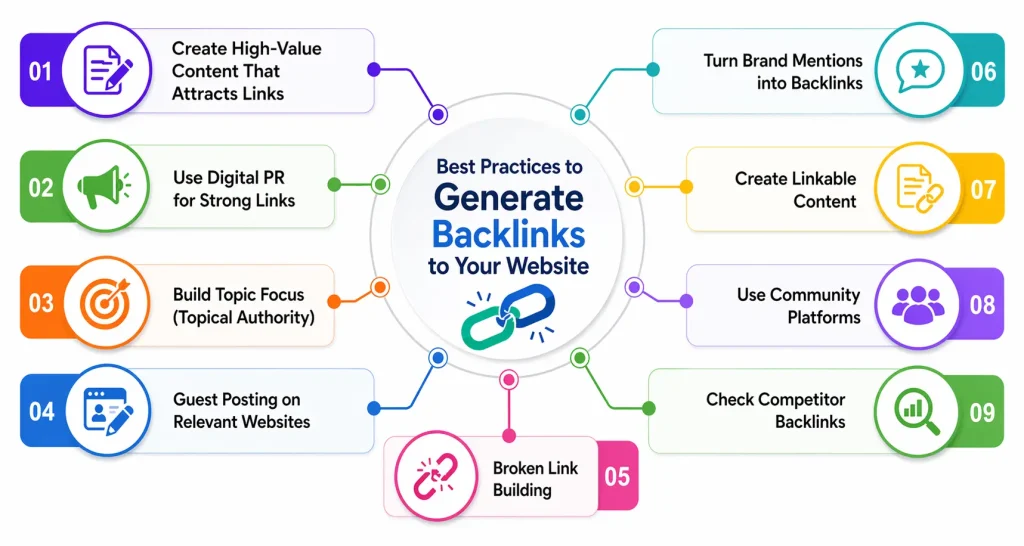
Getting backlinks today is not about placing links anywhere or in large numbers. It is about creating useful and clear content so that other websites naturally refer to your pages. When your content solves real problems and is easy to understand, people are more likely to link to it. Let’s look at some of the best practices to generate backlinks to your website below.
Create High-Value Content That Attracts Links
High-value content that attracts links is built on clarity, usefulness, and real problem-solving. When your content genuinely helps users understand a topic or solve an issue, other websites are more likely to reference it naturally. Instead of writing surface-level information, focus on creating detailed and practical guides that walk the reader through each step in a simple and easy-to-follow way.
Real examples and case studies make your content more trustworthy because they show how things work in real situations. Clear structure and simple language also matter, as readers and publishers prefer content that is easy to understand without confusion. Whenever possible, include useful data, insights, or research that adds depth and credibility to your topic. You can also increase value by offering free resources such as templates, tools, or downloadable materials that users can actually use. The main goal is to focus entirely on solving user problems in a way that feels practical, reliable, and genuinely helpful, because content like this naturally earns backlinks over time.
2. Use Digital PR for Strong Links
Digital PR is a strategy where you create valuable, informative, and newsworthy content that naturally attracts attention from other websites. Instead of directly requesting backlinks, the focus is on producing content that is so useful and relevant that publishers, bloggers, and media platforms want to reference it on their own. This approach works effectively because news sites and industry blogs are always looking for credible information, data, and expert insights to support their articles and strengthen their content.
To succeed with Digital PR, you should focus on creating original industry reports and meaningful insights that reflect real trends and developments. Sharing survey results or data-based findings adds strong credibility because it provides evidence-backed information that others can trust and cite. Offering expert opinions on important topics also helps position your brand as an authority in the field, making it more likely for journalists and bloggers to reference your views. Creating content around current trends ensures relevance and increases the chances of timely coverage, especially when topics are already being discussed widely.
3. Build Topic Focus (Topical Authority)
Topical authority refers to building your website around one clear subject and covering it in deep detail so that search engines and users recognize your site as an expert source in that area. Instead of publishing unrelated or random topics, the focus should be on developing a strong content ecosystem that revolves around a single niche. This helps create consistency and signals expertise, which improves trust and visibility over time.
To build topical authority, it is important to stay focused on one main niche and avoid spreading content across too many unrelated subjects. You should regularly publish articles that are closely related to your core topic so that your website gradually becomes a complete resource in that field. Internal linking plays a key role in this process because it connects related pages together and helps both users and search engines understand the structure of your content. A strong topical strategy also includes covering subjects from basic to advanced levels, ensuring that you provide value for beginners as well as more experienced readers. As your content depth increases and your subject coverage becomes more complete, your website naturally builds stronger authority and gains more trust from search engines and other websites.
4. Guest Posting on Relevant Websites
Guest posting is the process of writing articles for other websites in your niche to reach a new audience and earn high-quality backlinks. It is most effective when the content is created with a strong focus on value rather than just link placement.
To get good results, you should choose relevant and trusted websites that match your industry. The content should be simple, clear, and helpful so it genuinely engages readers and solves their problems. Any links you add should fit naturally within the content and support the topic instead of feeling forced or promotional. It is also important to avoid keyword stuffing or over-optimization, as this can reduce the quality and trust of your article. The main priority should always be delivering useful information to readers. Over time, consistently publishing quality guest posts helps build authority, improve visibility, and develop strong long-term relationships with website owners.
5. Broken Link Building
Broken link building is a strategy where you identify non-working or outdated links on other websites and suggest your own relevant content as a replacement. It is effective because it creates value for both parties, as website owners can fix broken resources while you gain a meaningful backlink in return.
To use this method successfully, you need to focus on finding broken references within websites that belong to your niche. Once identified, you should create or already have high-quality, updated content that provides better and more useful information than the original source. When reaching out to website owners, communication should always be polite and professional, clearly explaining the issue and offering your content as a helpful alternative. The replacement you suggest should be highly relevant so that it fits naturally within their existing page. The goal is to make the process easy and valuable for them while ensuring your content genuinely improves their user experience. Over time, this approach helps you earn clean, natural backlinks and strengthens your website’s authority in a sustainable way.
6. Turn Brand Mentions into Backlinks
Sometimes other websites mention your brand, product, or content without adding a clickable link. These unlinked mentions are valuable opportunities to earn backlinks because the website has already shown trust in your brand by referencing it.
To use this strategy effectively, you should regularly monitor where your brand is being mentioned online using alerts or tracking tools. Once you find unlinked mentions, reach out to the website owner in a polite and professional way, thanking them for the mention and requesting if they can add a link for better user experience. Since they have already included your brand, the chances of getting the link are usually high. This not only helps you gain backlinks but also improves your brand authority, online reputation, and overall SEO strength in a natural and sustainable way.
7. Create Linkable Content
Linkable content refers to high-value content that naturally attracts backlinks because it is useful, practical, and worth referencing. Instead of focusing on promotion, the main goal is to create content that other writers and websites genuinely want to cite in their own articles.
This works best when your content solves real problems or provides unique insights that are not easily available elsewhere. You can create tools, calculators, checklists, templates, industry reports, and detailed guides that offer long-term value to users. Adding original research or data can make your content even more powerful and shareable. Keeping your content evergreen ensures it stays relevant for a long time and continues to earn backlinks without extra effort. Over time, this type of content becomes a strong asset that consistently supports your SEO growth.
8. Use Community Platforms
Community platforms help you increase the visibility of your content and connect with real users who are actively looking for information. This exposure improves your chances of earning backlinks naturally as more people discover and share your work.
You can share your content on forums, discussion groups, and question-based platforms where users engage in niche-related conversations. Platforms like Reddit, Quora, and LinkedIn groups are especially useful because they allow you to interact directly with your target audience. Instead of simply posting links, focus on answering questions, providing solutions, and sharing insights in a helpful way. This builds trust and authority, and over time, your content gets noticed by bloggers and website owners who may reference it in their own articles, creating indirect backlink opportunities.
9. Check Competitor Backlinks
Studying competitor backlinks is one of the most effective ways to discover proven link-building opportunities. It helps you understand where other websites in your niche are getting their links from, so you can target similar sources instead of starting from scratch.
By analyzing competitor backlink profiles, you can identify high-authority websites, guest posting opportunities, and resource pages that are already linking to similar content. You can also observe what type of content attracts the most backlinks, such as guides, statistics, or case studies, and use this insight to improve your own strategy. This approach saves time, reduces guesswork, and allows you to focus on opportunities that are already working in your industry, increasing your chances of building a strong and competitive backlink profile.
What to Avoid in Link Building
Link building can really help your website grow, but only when it is done in the right way. If you use wrong methods, it can do more harm than good. Search engines are smart enough now to detect fake or low-quality links, so shortcuts are not worth it.
- Paid Spam Links: Buying links from random or low-quality websites is risky. These links may look helpful at first, but they do not bring real value. In many cases, they can reduce trust and affect your rankings over time.
- Private Blog Networks (PBNs): PBNs are groups of websites made only to create backlinks. They usually don’t have real users or useful content. Because of this, search engines can easily detect them, and using them can hurt your site’s performance.
- Low-Quality Directory Links: Some directories allow you to add your website, but many of them are not useful anymore. They often have no real audience, and links from these sites do not help much with rankings. In some cases, they can even look unnatural.
- Over-Optimized Anchor Text: Anchor text is the clickable part of a link. If you keep using the same keyword again and again, it starts looking unnatural. A healthy backlink profile always uses a mix of brand names, simple words, and different phrases.
- Automated Link Building Tools: Tools that create backlinks automatically may look easy, but they are not safe. Most of the links they create are low quality and have no real value. Manual link building always works better for long-term results.
Common Mistakes You Should Avoid in Link Building
Many websites do not fail because of lack of effort, but because of wrong link-building practices. Avoiding these mistakes is important if you want a clean and stable backlink profile.
- Focusing only on link quantity instead of quality, which weakens long-term ranking potential
- Ignoring relevance and getting backlinks from unrelated websites that do not support topic authority
- Repeating the same anchor text too often, which creates an unnatural linking pattern
- Using automated tools to generate mass backlinks, which often leads to low-quality links
- Publishing guest posts only for link placement instead of providing useful, value-based content
- Not tracking backlink sources, which makes it difficult to understand link quality and performance
- Ignoring content quality after acquiring backlinks, reducing the long-term impact of link-building efforts
Avoiding these mistakes helps maintain a natural backlink profile that supports steady and reliable search performance over time.
Conclusion
Backlinks are still one of the most important parts of SEO, but the way they work has changed a lot. It is no longer about getting as many links as possible. Instead, the focus is on quality, relevance, and natural placement.
When you follow the right approach to generate backlinks, it helps you build real trust for your website. They show search engines that your content is useful, clear, and worth showing to users. The key is to stay consistent and avoid shortcuts. Simple methods like creating helpful content, using natural link building strategies, and focusing on relevant websites make a big difference over time.
If you follow these Best Practices to Generate Backlinks to your website properly, your website can slowly build strong authority, better rankings, and steady search visibility without depending on risky methods.
Frequently Asked Questions (FAQs)
1. What are backlinks?
Backlinks are links from one website to another. When another site links to your page, it is called a backlink. It helps search engines understand that your content is useful.
2. Why are backlinks important for SEO?
Backlinks are important because they act like trust signals. When good websites link to your content, search engines see your page as more reliable and may rank it higher.
3. How can I get backlinks for my website?
You can get backlinks by writing helpful content, sharing useful information, guest posting on related websites, and creating content that others want to reference.
4. Are all backlinks good for my website?
No, not all backlinks are helpful. Links from low-quality or unrelated websites can harm your SEO. It is better to focus on natural and relevant backlinks.
5. Can new websites also get backlinks?
Yes, new websites can get backlinks by publishing useful content, sharing posts on social platforms, and slowly building trust in their niche.