
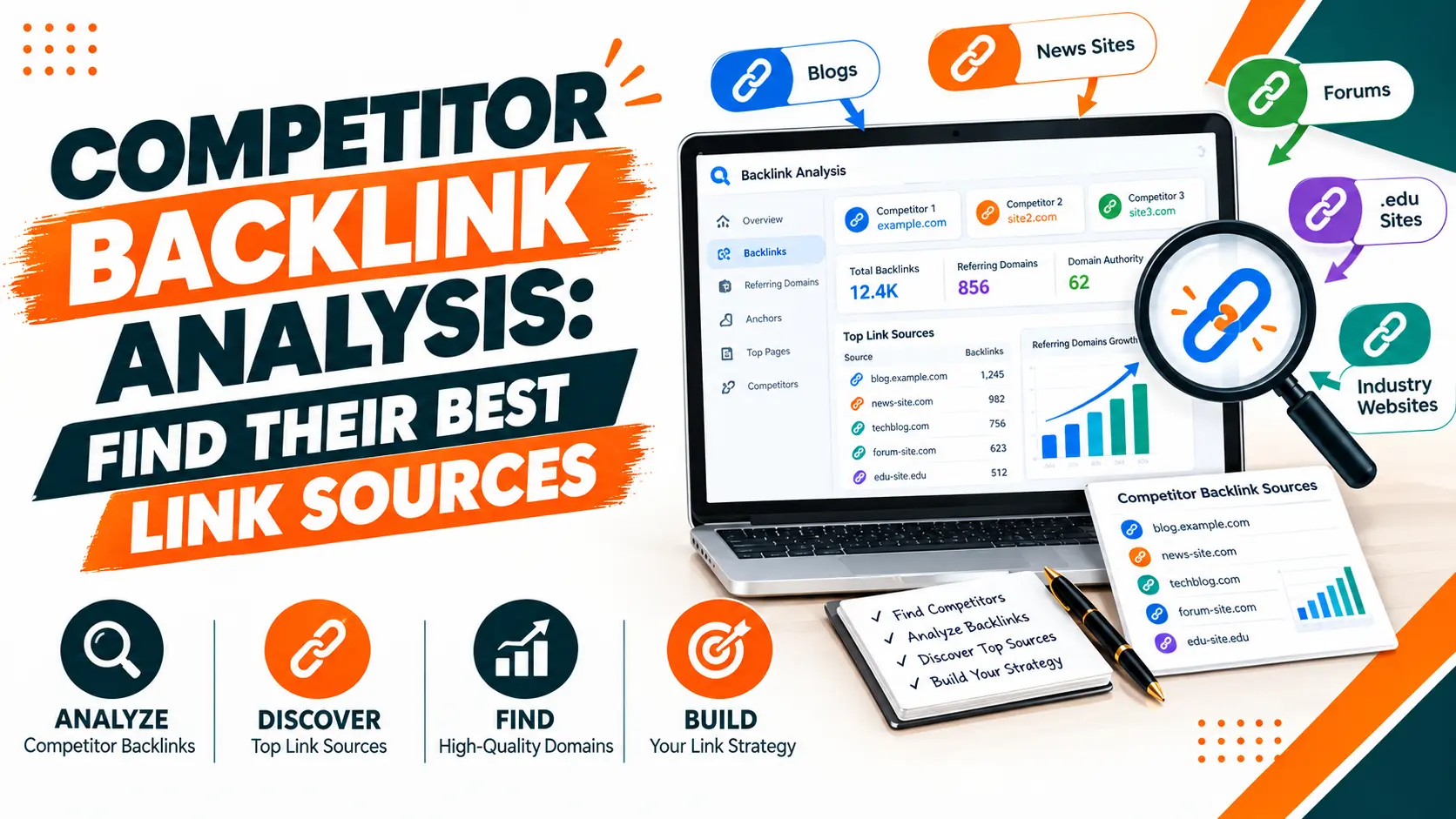
Your competitors can tell you a lot about where to look for backlinks. When a website links to several businesses in the same industry, there is already a reason for that connection. It could be a useful resource, an expert quote, original research, a directory listing, or a piece of content worth referencing.
A competitor backlink analysis helps you find these linking websites and work out which ones are actually worth pursuing. Instead of copying a competitor’s entire backlink profile, you can use it to find link gaps, understand what attracts links, and create better opportunities for your own website.
What Is Competitor Backlink Analysis?
Competitor backlink analysis is the process of examining the websites and pages that link to your SEO competitors. Instead of looking only at how many backlinks a competitor has, you investigate where those links come from and what caused the link.
A useful analysis looks at referring domains, linking pages, target URLs, anchor text, link attributes, and new or lost backlinks. Tools such as Ahrefs and Semrush can help collect this data, but the important part is understanding what the data means.
This is different from a backlink audit. A backlink audit evaluates your own link profile for quality and potential issues, while competitor analysis looks outward for patterns and opportunities.
Why Analyze Competitors’ Backlinks?
A competitor’s backlink profile can reveal websites, content formats, and promotional methods that are already relevant to your industry. That makes it useful for finding prospects without starting your research from zero.
Find Websites Already Linking to Your Market
Rather than searching for hundreds of websites manually, you can start with domains that have already linked to businesses competing for the same search traffic.
Identify Backlink Gaps
A backlink gap shows where competitors have links that your website does not. The most useful gaps are usually domains linking to several competitors but not to you.
Discover Linkable Content
Look at the pages attracting links. A competitor may be earning backlinks because of original research, a useful tool, a detailed guide, statistics, or another resource.
Understand Why Competitors Earn Links
The backlink itself is only part of the information. The linking page can show whether the competitor earned the mention through research, PR, expert commentary, a resource page, an industry listing, or another type of promotion.
What to Look at in a Competitor’s Backlink Profile
Do not treat every backlink as an opportunity. First look for patterns that can tell you which links are relevant, repeatable, and worth investigating.
| Metric | What It Tells You | What to Watch For |
| Referring domains | How many different websites link to the competitor | Repeated domains across competitors |
| Link relevance | Whether the website and page relate to your industry | Topically relevant sites |
| Authority and traffic | Context about the potential value of a domain | Quality alongside metrics, not metrics alone |
| Anchor text | How the competitor is referenced | Natural, descriptive wording |
| Target pages | Which competitor pages attract links | Pages with several referring domains |
| Link attributes | Whether a link is marked nofollow, sponsored, or ugc | Context, not the attribute alone |
| New and lost links | Recent link activity | Consistent or notable changes |
| Link velocity | How quickly links were acquired | Useful as context, not a target |
Links can be tagged nofollow, sponsored, or ugc. Google treats these as hints, not strict rules, so a nofollow link from a relevant site with real readers can still be worth pursuing.
How to Do a Competitor Backlink Analysis
You don’t have to go through every backlink a competitor has. The idea is to find the links that could actually be useful for your website and understand how your competitors earned them. Here are the steps to follow.
Step 1: Identify Your SEO Competitors
Search your main target keywords and note the websites that repeatedly appear. Choose 3–5 competitors with a similar audience, business model, and search visibility.
Step 2: Collect Their Backlink Data
Enter those competitors into Ahrefs or Semrush. Start with referring domains and linked pages, then collect the linking domain, linking URL, target URL, anchor text, and link type.
Step 3: Find Domains Linking to Multiple Competitors
Look for websites that link to two or more competitors. These are useful starting points because the site has already shown an interest in your market.
Step 4: Find Your Backlink Gaps
Use a Link Intersect or Backlink Gap report to find domains that link to competitors but not your site. Prioritize gaps appearing across multiple competitors.
Worked example: Suppose you run a project management software company. Compare your domain with three competitors using Ahrefs Link Intersect or Semrush Backlink Gap. Filter for websites linking to at least two competitors but not you, then remove irrelevant domains. The remaining industry blogs, software roundups, and resource pages become your priority prospects.
Step 5: Open the Actual Linking Page
Do not judge an opportunity from the referring domain alone. Open the page containing the link and see exactly where and why the competitor was mentioned.
Step 6: Find Out Why the Competitor Got the Link
Classify the link based on what you find. It may be a citation, resource recommendation, expert contribution, original research, tool, industry listing, or PR mention.
Step 7: Compare Their Linked Page With Your Content
Check the page your competitor received the link to. Ask whether your site has something that serves the same purpose. If not, note the content gap.
Step 8: Remove Irrelevant and Low-Quality Opportunities
Check topical relevance, page quality, audience fit, editorial standards, and the surrounding link context. Remove irrelevant or clearly low-quality prospects.
Step 9: Prioritize the Opportunities
Start with prospects where you have a clear reason to earn a mention. Give extra attention to domains linking to multiple competitors and pages closely related to your topic.
Step 10: Choose the Right Action
Match the opportunity to the reason for the original link. A resource mention may need a useful page, while an expert article may require expertise or original insight. Do not send the same pitch to every prospect.
What Types of Competitor Backlinks Are Worth Investigating?
Not every competitor backlink can or should be replicated. The most useful opportunities usually have a clear reason for the publisher to mention your website.
Editorial Mentions
These are links placed naturally within articles, reports, or other editorial content. Check whether your competitor was cited because of original information, expertise, research, or a useful resource.
Resource Pages
Resource pages can link to guides, references, tools, studies, and other useful material. Check what criteria the page appears to use before suggesting your own resource.
Expert Contributions
Some competitors earn links through expert quotes, interviews, guest contributions, or industry commentary. These opportunities depend on whether you can provide relevant expertise or information. Avoid large-scale guest posting campaigns built around keyword-rich anchor text, which Google’s spam policies warn against.
Digital PR
News coverage and industry publications can generate backlinks when a company has something genuinely newsworthy to discuss. Look for the story or data behind the coverage rather than simply targeting the publication.
Tools and Linkable Assets
Calculators, original studies, statistics, templates, research reports, and other useful assets can attract links because they provide something publishers want to reference.
Industry Listings
Industry associations, professional directories, local organizations, and relevant business listings can sometimes provide legitimate opportunities. Relevance matters more than collecting directory links in bulk.
How to Qualify a Competitor Backlink Opportunity
A competitor backlink is a prospect, not an automatic target. Before adding it to your outreach list, check the actual website and linking page.
Is the website relevant? The site’s subject, audience, and content should make sense for your business.
Is the linking page useful? A good domain can still contain pages that are irrelevant, outdated, or unsuitable for your content.
Why did the competitor receive the link? Identify the specific reason behind the mention. This tells you what type of opportunity you are actually looking at.
Do you have something worth linking to? A publisher needs a reason to replace or add a reference. Your page should provide useful information, original data, expertise, or another clear value.
Is the opportunity legitimate? Remove obvious spam, irrelevant sites, paid links, link exchanges, and pages created mainly to manipulate search rankings. Google’s spam policies list buying links for ranking purposes, excessive link exchanges, automated link creation, and low-quality directory links as violations.
Warning Signs of Toxic or Manipulative Links
Skip prospects that show these signs, even if a competitor has a link from them:
- Link networks or private blog networks
- Paid placements with no disclosure
- Comment, forum, or profile spam
- Automated or mass-produced links
- Sites with no real audience, thin content, or no editorial standards
- Low-quality directories that accept any submission
A high authority metric does not automatically make an irrelevant website a good backlink prospect.
Competitor Backlink Analysis Tools
| Tool | Best For | Key Feature | Free Option |
| Ahrefs | Deep link-gap research | Link Intersect | Free backlink checker (limited) |
| Semrush | Comparing several competitors | Backlink Gap | Limited free Reports |
| Moz | Cross-checking data | Link Explorer, Spam Score | Limited free queries |
| Majestic | Link quality and topic analysis | Topical Trust Flow | Limited free checks |
| Google Search Console | Your own links only | Links report | Free |
You do not need every SEO tool for competitor backlink research. Use one primary platform and a second tool when you need to verify data or find additional opportunities.
Ahrefs
Ahrefs provides data on backlinks, referring domains, linked pages, anchor text, and competitor link gaps. Its Link Intersect feature is particularly useful for finding websites that link to your competitors but not to your site.
Ahrefs also offers limited free access to some backlink-checking data, but its more advanced competitor comparison and reporting features require a paid plan.
Semrush
Semrush provides backlink reports and its Backlink Gap tool lets you compare your domain with multiple competitors. You can use it to identify common referring domains and filter for websites linking to competitors but not your site.
Some Semrush tools and reports have limited free access, while broader backlink research and competitor analysis require a paid subscription.
Moz
Moz is a separate SEO platform with its own backlink database and metrics. Its link research tools can help you examine linking domains, inbound links, and link opportunities.
Moz can be useful as an additional source when you want to compare backlink data with another platform rather than relying on a single database.
Majestic
Majestic specializes heavily in link intelligence and has its own backlink index. It provides metrics such as Trust Flow, Citation Flow, and Topical Trust Flow, along with referring-domain and backlink data.
Majestic also provides limited free backlink checking and browser-based metrics, while deeper analysis and higher usage limits are available through paid plans.
Google Search Console
Google Search Console is useful for checking backlinks reported for your own website. It can show which sites and pages Google associates with your site, but it does not provide the same competitor backlink research features as Ahrefs, Semrush, Moz, or Majestic.
Use it alongside a dedicated backlink platform rather than as a replacement for competitor research.
Common Competitor Backlink Analysis Mistakes
Competitor research becomes less useful when the focus shifts from understanding opportunities to simply collecting numbers.
- Chasing backlink quantity. A larger backlink count does not automatically mean every link is worth pursuing.
- Copying every competitor link. Some links may be irrelevant, unavailable, low quality, or based on circumstances that cannot be reproduced.
- Relying only on authority metrics. A strong metric does not compensate for poor topical relevance or an unsuitable linking page.
- Ignoring the linking page. The domain may look promising until you inspect the actual page and discover why the link was placed.
- Sending generic outreach. Your pitch should relate to the page, its audience, and the reason your resource could be useful.
- Ignoring content gaps. Sometimes the real opportunity is not outreach. It is creating the resource that publishers have a reason to reference.
- Trying to match link velocity. Competitor link acquisition is useful context, but there is no need to reproduce another site’s exact pace.
- Assuming backlinks explain rankings. Backlinks are only one part of organic search performance. Content quality, relevance, technical factors, internal linking, search intent, and other signals also matter.
Conclusion
A competitor backlink analysis can reveal where your competitors are earning links and what makes those links valuable. Start by comparing relevant competitors, finding shared referring domains, and checking the actual pages behind promising backlinks. Look beyond metrics and identify the reason for each mention before deciding whether it is worth pursuing. Some opportunities may require outreach, while others may point to a missing asset such as original research, useful data, a tool, or a detailed resource. Remove irrelevant or low-quality prospects rather than trying to copy every backlink. The final goal is a focused prospect list and a clear link-building plan that your website can realistically execute.
Frequently Asked Questions (FAQs)
Q. What is competitor backlink analysis?
Competitor backlink analysis is the process of studying the websites and pages linking to your SEO competitors to identify relevant backlink opportunities, content gaps, and link-building patterns.
Q. How do I find my competitors’ backlinks?
Use a backlink analysis platform such as Ahrefs or Semrush. Enter a competitor’s domain and review its referring domains, backlinks, linked pages, and anchor text. Free backlink checkers can show a limited sample if you don’t have a paid tool.
Q. How do I find backlinks my competitors have but I don’t?
Use a Link Intersect or Backlink Gap report to compare your website with several competitors. Filter for domains that link to competitors but not your site.
Q. Which competitor backlinks should I try to replicate?
Focus on relevant, legitimate links where you understand why the competitor was mentioned and can provide a useful resource, expert contribution, data, or another valid reason for inclusion.
Q. How often should I analyze competitor backlinks?
A quarterly review is a practical starting point for many websites. More frequent checks can make sense in highly competitive industries or during an active link-building campaign.

Subash Kumar
Subash Kumar is a digital marketing strategist with over a decade of experience specializing in SEO, social media and data-driven content. He has helped brands achieve 150%+ growth in online visibility and increase engagement rates by up to 100% across technology, real state and ecommerce sectors. With a strong focus on analytics, Subash Kumar crafts campaigns that consistently drive results and deliver up to 5x ROI.