In digital marketing, one constant challenge is producing enough content without exhausting time, budget, or creativity. Studies from content marketing industry reports consistently show that marketers struggle most with content production volume and consistency. That’s exactly where repurposing content becomes a practical and efficient solution.
Instead of creating something new every time, you take existing high-value content and reshape it for different platforms and audience behaviors. A single strong idea can live in multiple formats such as blogs, videos, podcasts, social posts, and email campaigns without losing its meaning.
This approach is widely used by successful brands because it helps maintain consistency while reducing production pressure. It is not about duplication; it is about strategic reuse with purpose.
What is Repurposing Content?
It is the process of taking one piece of content and converting it into multiple formats while keeping the core message intact. It is one of the most practical strategies in modern content marketing because audiences consume information differently across platforms.
For example:
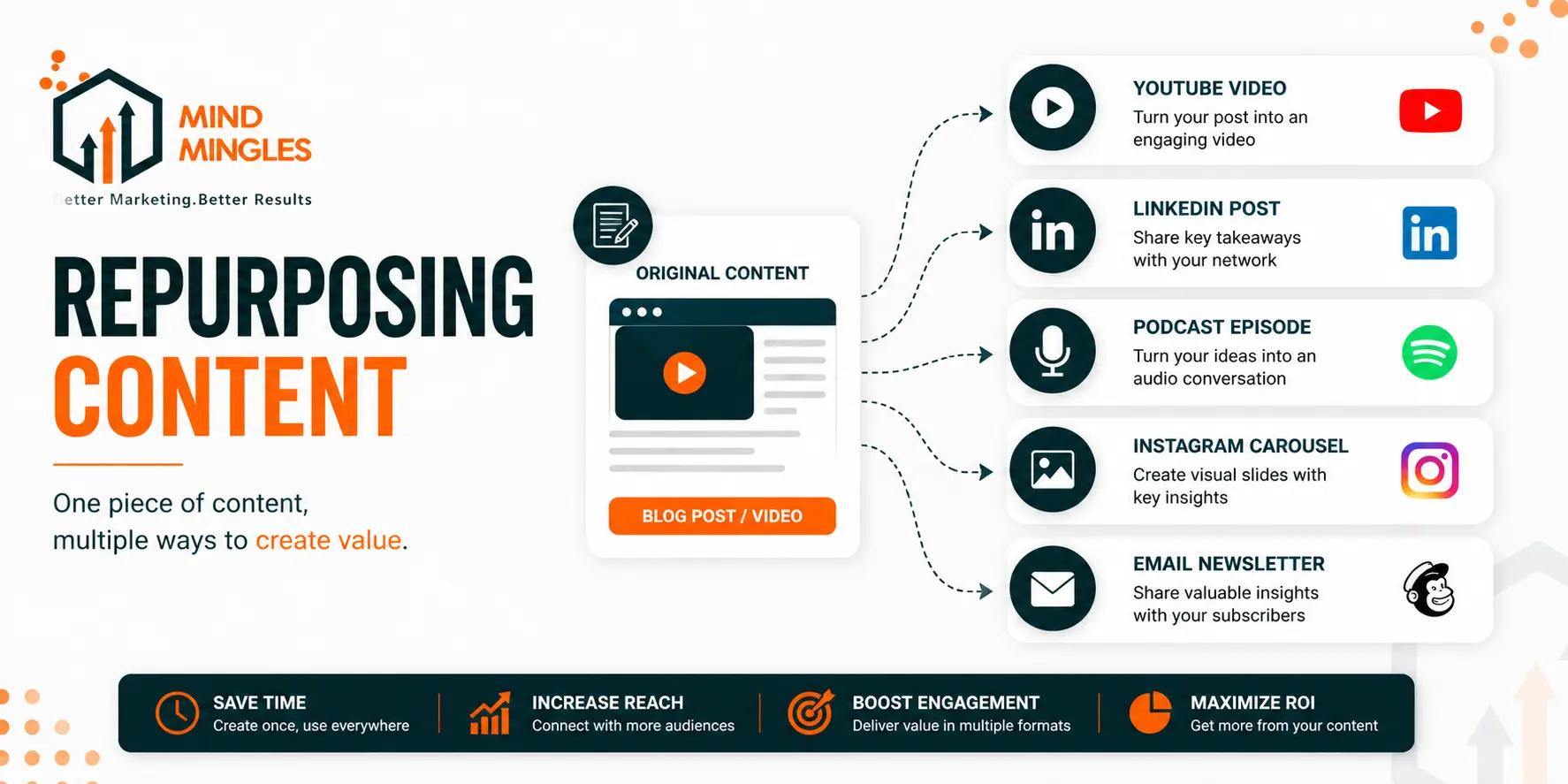
- A 2,000-word blog post can become 5–10 LinkedIn posts
- The same blog can be turned into a 3–5 minute video
- Key points can be converted into an infographic
- Insights can be sent as an email series
According to content marketing research trends, businesses that reuse content strategically often produce significantly more output with the same resources compared to those constantly creating from scratch. In simple terms, it means making one idea work in many places instead of letting it stay in one format.
Why Repurposing Content Has Become Important in 2026
The internet is filled with content, with millions of new blog posts published every day. Social media platforms also prioritize fresh and engaging updates, which makes visibility more competitive than ever. In this environment, simply creating good content is not enough—how you distribute it matters just as much.
Research shows that most content gets very little traffic after its initial push. Many posts lose attention quickly, even if the information is valuable. This is where repurposing content becomes useful because it gives your content a longer life and more chances to reach different audiences.
A single idea can work in multiple ways. A blog post can rank on search engines, a video version can reach YouTube viewers, a short clip can perform on Instagram or TikTok, and a summary can reach email subscribers. Instead of one opportunity, your content gets several chances to perform across platforms. This is why marketers rely on content repurposing; it increases output and reach without requiring extra effort every time.
Benefits of Repurposing Content
It helps improve SEO, reach more people, and make your content more efficient by turning one piece into multiple formats. Let’s look at the benefits below.
Stronger SEO Performance and Visibility
Search engines reward content that appears in different useful formats. When you apply repurposing content, you naturally create more entry points for search traffic.
For example, a single article can be optimized for:
- Primary keyword: content marketing strategy
- Secondary keywords: content recycling, content reuse strategy, content distribution
- Long-tail variations through video descriptions and social posts
HubSpot-style content studies often show that businesses publishing consistently across formats generate significantly more indexed pages, improving organic visibility.
Saves Time and Reduces Production Pressure
Creating new content from scratch takes time—research, outlining, writing, editing, designing, and publishing. On average, a long-form blog can take several hours to a full day depending on complexity.
Repurposing content reduces that workload significantly. Instead of 10 separate ideas, you create one strong idea and convert it into multiple assets.
For example:
- 1 blog → 6 social posts
- 1 video → 1 blog + 3 clips
- 1 webinar → 4 articles + email series
This makes content production more predictable and less stressful, especially for small teams.
Expands Audience Reach Across Platforms
Different platforms attract different user behaviors. A LinkedIn user expects professional insights, while an Instagram user prefers quick visuals.
By using repurposing content, you adjust the same idea for different audiences.
For instance:
- Blog readers prefer detailed explanations
- Video audiences prefer visual storytelling
- Social media users prefer short insights
A single message, when adapted properly, can reach multiple audience segments without losing clarity.
Builds Strong Brand Recall and Authority
Repetition across formats strengthens memory. When users repeatedly see the same idea in different places, they begin associating it with your brand.
Marketing psychology shows that repeated exposure increases familiarity, which builds trust over time. This is why brands often distribute the same message across blogs, ads, videos, and emails. Repurposed content helps maintain that consistency without sounding repetitive when done correctly.
Best Types of Content for Repurposing
Different content formats work differently, but some are naturally easier to reuse and reshape. When you apply repurposing content, choosing the right source material makes a big difference in how much value you can extract from it.
Blog Posts
Blog posts are one of the most useful formats for repurposing because they already contain structure, headings, and detailed explanations. A single well-written article can be broken into multiple smaller content pieces without losing meaning.
From one blog, you can create short social media posts, email newsletters, video scripts, or even infographic content. Since blogs already explain a topic in depth, they act as a strong base for almost any repurposing content strategy.
Videos
Videos are highly flexible because they combine visuals and information together. A longer video can easily be converted into smaller clips, reels, or short highlights for social media platforms.
For example, a tutorial video can be reused as a step-by-step blog post, a series of quick tips, or even a short caption-based post. This makes video content valuable for reaching audiences who prefer fast, visual consumption.
Podcasts
Podcasts are rich in conversation, insights, and explanations, which makes them ideal for reuse. A single episode can be transformed into written articles, quote posts, or summary-based newsletters.
This format works especially well when you want to reuse natural discussions and turn them into structured written content. It helps extend the reach of spoken content into readable formats.
Webinars
Webinars usually contain detailed teaching, demonstrations, and Q&A sessions, which makes them a strong source for repurposing. One webinar can be broken into guides, blog posts, or even eBooks. This allows a single live session to continue generating content long after it ends, making it a valuable long-term content asset.
Effective Strategies for Repurposing Content
To get better results from repurposing content, you need a clear structure instead of random reuse. The idea is to extend the life of your content while keeping it useful, clear, and relevant across platforms.
- Break Long Content into Smaller Units
Long-form content works best when divided into smaller parts. A single blog can be turned into multiple social media posts, short tips, or quote cards. This makes the content easier to read and more suitable for fast-scrolling platforms where attention is limited. - Update and Refresh Old Content
Older content often loses traffic when information becomes outdated. Refreshing it with new statistics, examples, or current insights can help it regain visibility in search results. In many cases, updated content performs better than new content because it already has authority and search history. - Convert Across Formats
One of the strongest repurposing content methods is changing formats based on platform needs. A blog can become a video, a podcast can be rewritten as an article, and a webinar can be converted into an eBook. This allows one idea to perform across multiple channels instead of staying limited to one format. - Focus on High-Performing Content First
Start with content that already performs well, such as high-traffic pages, top-ranking articles, or widely shared posts. This ensures your effort is spent on content that already has proven value and audience interest, increasing the chances of success when repurposed.
Tools That Make Repurposing Easier
Several tools can simplify repurposing content by helping you analyze performance, redesign formats, and rewrite material quickly. Here are some useful ones with their purpose:
- Ahrefs – Helps you find high-performing pages, keyword opportunities, and content that is worth repurposing.
- SEMrush – Used for SEO analysis, tracking rankings, and identifying content gaps you can reuse or improve.
- Canva – Converts text-based content into visuals like infographics, carousel posts, and social media graphics.
- Descript – Helps edit, transcribe, and convert audio or video content into written form quickly.
- Grammarly – Improves readability and helps rewrite or refine repurposed content for clarity.
- ChatGPT or similar writing tools – Assists in summarizing, rewriting, and transforming long content into different formats.
Using these tools makes repurposing content faster, more consistent, and easier to manage across multiple platforms.
Real-Life Case Scenarios
It becomes much easier to repurpose content when you see how it works in real situations. Many brands and creators use this strategy daily to maximize output from a single idea.
Case Scenario 1: Blog to Full Content Ecosystem
A digital marketing agency publishes a detailed 2,500-word blog on “SEO strategies for beginners.” Instead of stopping there, they break it into multiple assets.
The blog is converted into short LinkedIn posts, each explaining one SEO tip. The same content is turned into a 5-minute YouTube video. Key points are designed into Instagram carousel posts, and a summary version is sent as an email newsletter.
As a result, one blog generates content for an entire week across multiple platforms without creating anything new from scratch.
Case Scenario 2: Webinar to Multi-Platform Content
A SaaS company hosts a 60-minute webinar on productivity tools. The session is recorded and later repurposed.
The video is edited into short clips for social media. The transcript is turned into three separate blog posts focusing on different sections of the webinar. Key insights are also converted into a downloadable guide for lead generation.
This approach extends the value of a single event into long-term marketing content.
Case Scenario 3: YouTube Video to SEO Blog
A content creator uploads a 15-minute YouTube video explaining keyword research. Later, the video is converted into a structured SEO blog post.
The spoken explanation becomes written sections with headings, examples, and FAQs. Screenshots from the video are reused as visuals in the blog. The blog then starts ranking on Google and brings in consistent organic traffic.
This shows how one video can perform in both search and video platforms when repurposed properly.
Case Scenario 4: Podcast to Social Media Series
A marketing podcast episode discussing branding is broken into multiple short content pieces.
Each key insight becomes a quote post for Instagram and LinkedIn. A written summary is published as a blog article, and highlights are shared as short audio clips.
This allows a single podcast episode to stay active across platforms for weeks instead of just one release cycle.
Conclusion
In the end, repurposing content is one of the most practical ways to get more value from your existing work without constantly creating new material. Instead of treating every blog, video, or podcast as a one-time effort, you turn it into multiple formats that continue to perform across different platforms.
This approach helps you maintain consistency, reduce production pressure, and improve overall content reach. It also supports better SEO performance by increasing visibility across search engines and social platforms. When done with proper planning, repurposing becomes a long-term system that keeps your content active, relevant, and useful for a longer period.
FAQs
How do I start repurposing content as a beginner?
Start with one strong piece of content, usually a blog or video. Then break it into smaller parts like social media posts, short videos, or email content. Focus on simple formats first instead of trying everything at once.
Which content should I repurpose first for better results?
Begin with content that already performs well—pages with high traffic, good engagement, or strong search rankings. These already have proven value, so repurposing them gives better chances of success.
How many times can I repurpose one piece of content?
There is no fixed limit. One blog can be reused multiple times across platforms as long as each version is adapted properly for the audience and format.
Does repurposing content work for small businesses or solo creators?
Yes, it is especially useful for them because it saves time and reduces the need to constantly create new content while still maintaining an active online presence.
What is the biggest mistake in repurposing content?
The most common mistake is copying content without changing the format or tone. Each platform needs its own style, otherwise engagement drops even if the information is good.