SaaS content marketing is a specialized strategy focused on creating and distributing valuable, relevant content to attract, engage, and convert prospects into customers for Software-as-a-Service (SaaS) businesses. In a highly competitive and rapidly evolving market, effective content marketing is essential for driving brand awareness, lead generation, customer retention, and sustainable growth. This guide provides a detailed, actionable framework for building a successful SaaS content marketing strategy in 2025, incorporating the latest trends, best practices, and insights from industry experts.
Why SaaS Content Marketing Matters
SaaS companies operate in a unique landscape where the product is intangible, subscription-based, and often complex. Content marketing is critical for:
Educating Prospects: SaaS solutions require in-depth explanation to demonstrate value and functionality, especially for technical or niche products. Content bridges the gap by simplifying complex ideas and addressing pain points.
Building Trust and Authority: In B2B SaaS, decision-makers research extensively before committing. High-quality content positions your brand as a trusted industry leader, fostering credibility.
Driving Organic Growth: Optimized content boosts search engine rankings, reducing reliance on paid ads and lowering customer acquisition costs over time.
Supporting the Entire Funnel: Content guides prospects through awareness, consideration, and decision stages while nurturing existing customers to reduce churn.
Highlighting Product Updates: SaaS products evolve constantly. Content keeps users informed about new features and use cases, enhancing engagement and retention.
In 2025, 55% of SaaS companies rely on content marketing as their primary strategy, underscoring its importance in a crowded market.
Key Challenges in SaaS Content Marketing
SaaS content marketing differs from traditional marketing due to:
Intangible Product: Unlike physical goods, SaaS requires content to visualize value and outcomes.
Complex Buyer Journey: B2B SaaS involves multiple stakeholders (technical teams, C-suite, end-users) with distinct needs, prolonging the sales cycle.
High Competition: With thousands of SaaS solutions, standing out demands unique, high-quality content.
Retention Focus: Subscription models prioritize customer retention, requiring ongoing engagement through content.
Rapid Product Evolution: Frequent updates necessitate agile content strategies to reflect new features and benefits.
A 10-Step SaaS Content Marketing Strategy for 2025
1. Define Clear Goals and KPIs
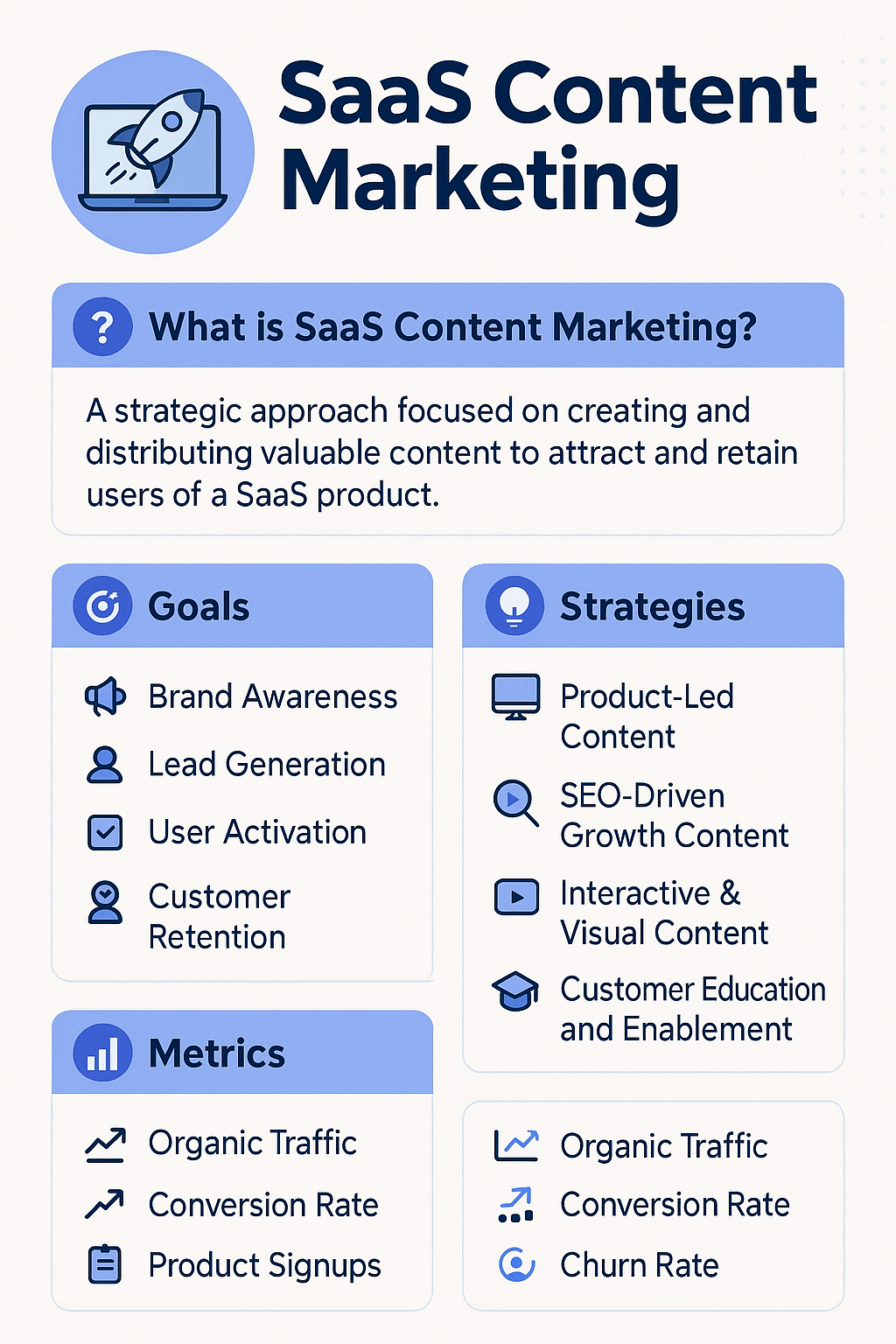
Align content marketing objectives with business priorities, using the SMART framework (Specific, Measurable, Achievable, Relevant, Time-bound). Common goals include:
Brand Awareness: Increase website traffic and social media engagement.
Lead Generation: Boost demo requests, trial signups, or email subscriptions.
Customer Retention: Reduce churn through onboarding guides and engagement content.
KPIs to Track:
Organic traffic and search rankings (Google Analytics, Search Console)
Conversion rates (signups, demos, purchases)
Engagement metrics (time on page, social shares)
Customer lifetime value (CLV) and churn rate
Regularly refine goals based on performance data and industry trends.
2. Understand Your Audience
Create detailed buyer personas to tailor content to specific segments. For B2B SaaS, consider:
Demographics/Firmographics: Job roles, company size, industry.
Pain Points: Challenges your SaaS solves (e.g., inefficiency, cost).
Goals: Desired outcomes (e.g., scalability, ROI).
Content Preferences: Preferred formats (blogs, videos, whitepapers) and channels (LinkedIn, email).
Research Methods:
Internal Data: Analyze CRM and website analytics for behavior patterns.
Customer Interviews: Uncover needs and preferences directly.
Surveys: Gather insights on pain points and content consumption habits.
Competitor Analysis: Identify gaps in competitors’ content to address unmet needs.
Example: A SaaS HR platform might segment audiences into small businesses (10-50 employees) and enterprises (>1,000 employees), creating personas for HR managers and CEOs with distinct content needs.
3. Conduct Keyword Research and SEO Optimization
SEO is the backbone of organic growth. Use tools like Ahrefs, SEMrush, or Google Keyword Planner to:
Identify high-intent keywords (e.g., “best CRM software for small businesses”).
Target long-tail keywords for niche audiences (e.g., “Hotjar vs. Crazy Egg for heatmaps”).
Monitor trending topics using Google Trends or Topic Research tools.
SEO Best Practices:
Optimize for search intent: Match content to what users seek (informational, navigational, transactional).
Create pillar pages and topic clusters to boost authority (e.g., a pillar page on “SaaS CRM Optimization” linking to subtopics like “CRM Data Management”).
Ensure technical SEO: Fast load times, mobile-friendliness, and crawlable site structure.
Build high-quality backlinks through guest blogging and partnerships, avoiding low-quality link schemes.
Example: Hotjar’s pillar page on heatmaps ranks for broad keywords like “heatmap software” and long-tail terms like “Hotjar vs. software X,” driving both awareness and conversions.
4. Map Content to the Buyer’s Journey
SaaS content must address each stage of the funnel:
Awareness (Top of Funnel): Attract prospects with educational content.
Blog posts (e.g., “10 Ways to Optimize Your Workflow”)
Infographics
Social media posts
SEO-optimized guides
Consideration (Middle of Funnel): Demonstrate value and build trust.
Case studies
Webinars
Interactive tools (e.g., ROI calculators)
Product tour videos
Decision (Bottom of Funnel): Convert prospects with high-intent content.
Demo videos
Customer testimonials
Comparison pages (e.g., “Your SaaS vs. Competitor X”)
Free trial offers
Retention (Post-Purchase): Engage customers to reduce churn.
Onboarding tutorials
Product update newsletters
Community forums
In-app prompts
Pro Tip: Prioritize bottom-of-funnel content first to capture high-intent prospects, then expand to middle and top-of-funnel topics.
5. Diversify Content Formats
Engage varied audience preferences with multiple formats:
Blog Posts: Evergreen how-to guides and industry trend analyses (minimum 1,900 words for SEO).
Videos: Demo videos, tutorials, and behind-the-brand stories (e.g., Toggl’s “Before Toggl, Tracking Time Was…”).
Whitepapers/E-books: In-depth resources for lead generation (e.g., Drift’s “Conversation Automation Technology”).
Case Studies: Showcase client success (e.g., SEMrush’s 28x traffic growth for Postalytics).
Podcasts/Webinars: Thought leadership and expert interviews.
Interactive Content: Quizzes, calculators, or embedded videos in whitepapers.
Social Media: Entertaining, platform-specific content (e.g., LinkedIn polls, Twitter threads).
Example: HubSpot’s mix of blogs, community forums, and educational guides caters to diverse learning styles, nurturing prospects and customers alike.
6. Create a Content Calendar
A content calendar ensures consistency and alignment with business goals. Include:
Topics/Themes: Plan around product launches, industry events, or seasonal trends.
Publishing Schedule: Start with a manageable cadence (e.g., one blog post and two social media updates weekly).
Content Types: Balance blogs, videos, and lead magnets.
Distribution Channels: Assign platforms (e.g., LinkedIn for B2B, Twitter for updates).
Use tools like Trello, Asana, or CoSchedule to manage workflows and deadlines.
7. Leverage Multi-Channel Distribution
Maximize reach by distributing content across:
Owned Channels: Website, blog, email newsletters.
Social Media: Repurpose content for platform algorithms (e.g., Twitter threads summarizing blog posts).
Paid Channels: PPC campaigns for immediate visibility, targeting high-intent keywords.
Communities: Engage in Reddit, LinkedIn groups, or industry forums to share expertise.
Email: Weekly newsletters and retention series for disengaged users.
Example: Mailshake repurposes blog posts into LinkedIn summaries and Twitter threads, linking back to the full article for deeper engagement.
8. Incorporate Account-Based Marketing (ABM)
ABM personalizes content for high-value accounts. For example:
Create bespoke reports for target enterprises (e.g., “How Our SaaS Saves Costs for Logistics Firms”).
Use LinkedIn ads and email sequences tailored to specific industries or roles.
Example: A SaaS HR platform might target fleet managers with case studies showing 20% efficiency gains, delivered via LinkedIn and email.
9. Measure and Optimize Performance
Track performance to refine your strategy:
Tools: Google Analytics, SEMrush, Hotjar for user behavior.
Metrics: Traffic, engagement, conversion rates, CLV, churn.
A/B Testing: Test headlines, CTAs, or formats to improve ROI.
Content Refresh: Update outdated posts with new data or insights (e.g., change “2024” to “2025” in titles).
Example: Identify high-performing content (e.g., case studies) and replicate their structure for other topics. Refresh underperforming posts with new visuals or keywords.
10. Stay Ahead of 2025 Trends
Adapt to emerging trends to stay competitive:
AI-Powered Content: Use AI tools for ideation and personalization, but maintain human oversight for quality.
Micro-SaaS Focus: Create niche content for underserved audiences (e.g., analytics tools for Shopify merchants).
Sustainability Messaging: Highlight eco-friendly practices to align with conscious buyers (e.g., Salesforce’s climate action plans).
Interactive Experiences: Invest in quizzes, calculators, or AR/VR demos to boost engagement.
Community Building: Foster online communities for peer-to-peer engagement (e.g., HubSpot’s forums).
Best Practices for SaaS Content Marketing
Focus on Quality Over Quantity: Produce fewer, high-value pieces (e.g., 12,000-word whitepapers) that resonate deeply.
Align with Product Teams: Stay updated on features to create relevant content.
Use Storytelling: Humanize your brand with client success stories or behind-the-scenes videos.
Avoid Over-Promotion: Social media content should entertain or educate, not just sell.
Maintain Consistency: A consistent voice and publishing schedule builds trust.
Invest in Visuals: Unique visuals (not stock images) enhance engagement.
Case Studies
Hotjar: Their pillar page on heatmaps ranks for broad and long-tail keywords, driving traffic and conversions through a logical, SEO-friendly structure.
SEMrush: By focusing on quality content, SEMrush helped clients like Postalytics achieve 28x organic traffic growth, positioning themselves as an authority.
HubSpot: A mix of blogs, guides, and community forums nurtures prospects and retains customers, reducing churn.
Marker.io: User-generated content and demo videos led to 600 upvotes and 3,000 signups on ProductHunt in one month.
Tools to Enhance Your Strategy
SEO: Ahrefs, SEMrush, Google Keyword Planner
Analytics: Google Analytics, Hotjar, Looker Studio
Content Management: Trello, Asana, CoSchedule
Social Media: Crowdfire, SocialPilot
Video Creation: Canva, Adobe Premiere Pro
AI Assistance: Jasper, Grammarly for ideation and editing
Conclusion
SaaS content marketing in 2025 is about delivering value through strategic, audience-centric content that educates, engages, and converts. By defining clear goals, understanding your audience, optimizing for SEO, and leveraging diverse formats and channels, you can build a scalable content engine that drives growth. Stay agile, track performance, and adapt to trends like AI, micro-SaaS, and sustainability to maintain a competitive edge. With consistency and quality, your SaaS brand can become a trusted authority, fueling long-term success.